Category: Real Estate Finance

  • Buy and Hold vs. Fix and Flip: Comparing Investment Strategies

    Two of the most popular real estate strategies sit at opposite ends of the time horizon. Buy and hold means owning a property for years, collecting rent while it (hopefully) appreciates. Fix and flip means buying a property, renovating it, and selling it quickly for a profit. Comparing buy and hold vs fix and flip comes down to how you want to earn, how much risk and work you can take on, and what each strategy costs after taxes.
    llustration of a house with a key and rising graph beside a house with a hammer and paint roller, for a post comparing buy and hold vs fix and flip.

    How each strategy makes money

    Buy and hold builds returns over time through several sources: monthly cash flow from rent, loan paydown as tenants effectively help pay off the mortgage, appreciation, and tax benefits such as depreciation. No single source has to carry the whole investment, which is part of the appeal.

    Fix and flip earns one profit at the end: the difference between what you pay and spend and what you sell for. Everything depends on buying well, controlling renovation costs, and selling at the right time.

    What flips actually earn

    Flipping profits can look impressive in headlines, but gross profit isn’t what you take home. According to ATTOM’s Q2 2026 home flipping report, the typical flip earned a gross profit of about $60,500, a 21.5% return on investment, down from 25.7% in the first quarter and 27.6% a year earlier. Flips made up roughly 6% of home sales in the quarter. “Gross” means before costs such as financing, insurance, taxes, and carrying costs during the project, and ATTOM’s figures are national, so Orange County deals will look different given higher prices and construction costs. The trend is the useful signal: margins have been narrowing, which leaves less room for error.

    Risk and workload

    Flipping is closer to running a small construction and sales business than to passive investing. You carry the risk that repairs run over budget, permits take longer than planned, or the market softens before you sell, and you’re paying interest and holding costs the whole time. Because profit depends on a single sale, a mistake on one project can erase the gain.

    Buy and hold spreads risk over time, but it has its own: vacancies, repairs, tenant issues, and the need to hold cash reserves. As we covered in our posts on how to run the numbers before buying a rental and how many properties is too many, the numbers and your capacity both matter. The work is steadier and more predictable, and much of it can be handed to a property manager.

    Taxes work differently

    Taxes can change the comparison significantly, and the rules are technical, so treat this as a general overview.

    Profit from a property held one year or less is generally taxed as ordinary income, at higher rates than long-term gains. If the IRS treats you as a “dealer,” meaning flipping is a business, the profits may also be subject to self-employment tax, and the property isn’t eligible for a 1031 exchange, which we explained in our post on 1031 exchanges. Rental owners who hold longer generally pay long-term capital gains rates on the sale, benefit from depreciation, and may use a 1031 exchange to defer taxes when they trade up. Which category applies depends on your facts, so a CPA is worth consulting before you choose a strategy.

    What about Orange County?

    High prices cut both ways. They raise the dollar profit potential on a successful flip but also the capital required and the cost of a mistake, and local permitting and construction costs can stretch timelines. For buy and hold, high prices mean thin starting yields, so the strategy often relies on appreciation and longer holding periods, which makes financing terms and reserves especially important, as in our post on how interest rates affect returns.

    Which fits you?

    Flipping tends to suit people with renovation experience, available time, and the capital and risk tolerance to absorb a bad project. Buy and hold tends to suit investors who prefer steady income, long-term growth, and the option to delegate management. Some investors combine them, using flip profits to fund rentals. Start with your goals, as we discussed in understanding your investment goals, and pick the strategy that supports them.

    This post is general information, not financial, tax, or legal advice. Results vary, and past performance doesn’t guarantee future results. Talk with a CPA and a qualified advisor about your situation.

    Building a rental portfolio and want help managing it? Reach out to Smart One Property Management.

    Sources: ATTOM, Q2 2026 Home Flipping Report coverage; BiggerPockets, The Ultimate Guide to House Flipping Taxes; Tellus, Short-Term Capital Gains on Real Estate: How Flippers Are Taxed.
  • Orange County Housing Market: What Buyers and Sellers Are Facing Right Now

    The Orange County housing market is in an unusual spot. Prices remain among the highest in the country, but the pace has changed: rates are elevated, more homes are sitting on the market than in recent years, and negotiating power is shifting. Here is where things stand heading into the holidays, and what it means for buyers, sellers, and rental owners.

    Illustration of houses with a for-sale sign and a tilted balance scale, for a post on the Orange County housing market.

    Rates are the main headwind

    Freddie Mac’s weekly survey put the average 30-year fixed mortgage rate at 7.24% on October 29, 2026, down slightly from 7.32% the week before but still well above where rates stood a year ago. At those levels, a monthly payment on a typical Orange County purchase is significantly higher than it would have been at last year’s rates, which pushes some buyers to the sidelines and forces others to adjust their budgets. As we covered in our post on how interest rates affect investment returns, even small rate changes move monthly costs substantially. Rates can change week to week, so check the latest figure before making decisions.

    Inventory is rising

    Several local market reports point to more homes for sale than Orange County has seen in years. One report puts active inventory above 5,000 homes, the highest since 2019, and others note homes taking longer to sell. The exact figures vary by source and by month, and we couldn’t verify them against a single official data set, so treat them as a direction, not a precise count.

    Condos appear to be the softest segment. At least one regional report describes record levels of price cuts among condo sellers across Orange County and Los Angeles.

    Prices: high, but not racing higher

    Prices haven’t collapsed. One report using CRMLS data puts the September single-family median at roughly $1.46 million, up about 4.7% from a year earlier, though other sources report different figures depending on which home types and areas they include. The takeaway is that prices have held up better than the rate environment might suggest, thanks to the long-running shortage of homes we’ve written about before, but price growth looks more modest and varies by city and property type.

    What it means for buyers

    Buyers who can manage today’s rates may have more room to negotiate than they have had in recent years. More choices and longer marketing times can mean room to ask for credits, repairs, or a price reduction, though well-priced homes in desirable areas still draw offers. Preparation matters: a strong pre-approval, a realistic budget at today’s rate, and flexibility on location or property type go a long way. Our posts on what buyers want in Orange County and whether fall is a good time to buy or sell cover more.

    What it means for sellers

    Sellers face a market where pricing matters more. Homes priced to the market can still sell quickly, while those priced on last year’s expectations tend to sit and need reductions. Condition and presentation also matter more when buyers have more options. Many longtime owners are sitting on substantial equity and low-rate mortgages, which is one reason they may hold off on selling. If you’re weighing a sale, it’s worth comparing it with the option of keeping the property as a rental, and our post on 1031 exchanges covers one way to defer taxes if you sell an investment property.

    What it means for rental owners

    When buying is expensive, more people rent for longer, which tends to support rental demand. As we’ve covered in our market reports, Orange County rents and vacancy vary a lot by city, so local comparables matter more than any countywide headline. For owners, the market makes accurate pricing and a well-maintained property more important than ever.

    This post is general information, not financial or real estate advice. Market conditions change quickly, and figures here come from third-party reports. Talk with a licensed agent and a mortgage professional about your situation.

    Thinking about selling, buying, or renting out a property? Reach out to Smart One Property Management.

    Sources: The Mortgage Reports, Mortgage Rates Today (Freddie Mac weekly survey data); Andrew Homes, Orange County Housing Market Report: September 2026; WIRE Associates, SoCal Market Report: September 2026; Orange County Home Prices Q3 2026: Single-Family Report.

  • How Interest Rates Affect Your Investment Return

    Interest rates are the single biggest line item for most financed rentals, which makes them one of the most powerful forces on your return. A change of just a point or two can turn a comfortable cash flow into a loss. Here is how interest rates affect investment property returns, with a worked example that shows the effect in dollars.

    Illustration of a house balanced on a see-saw between a percent sign and coins, for a post on how interest rates affect investment property returns.

    A simple example

    The numbers below are illustrative, not a prediction or a real property. Imagine a $500,000 rental purchased with 20% down ($100,000) and a $400,000 30-year fixed-rate loan. The property produces $30,000 a year in net operating income (NOI), which is rental income after operating expenses but before loan payments. That is a 6% cap rate, and it stays the same no matter what the rate is, because cap rate doesn’t depend on financing.

    Here is what happens at three different interest rates:

    Interest rateMonthly payment (principal and interest)Annual debt serviceAnnual cash flowCash-on-cash return
    5.5%$2,271$27,254+$2,7462.75%
    6.5%$2,528$30,339-$339-0.34%
    7.5%$2,797$33,562-$3,562-3.56%

    Same property, same rent, same tenant. A two-point swing in the interest rate moved the investor from a small profit to a loss of more than $3,500 a year. The property didn’t get worse; the cost of borrowing got higher. (These figures leave out taxes, insurance, reserves, and other costs, so real-world results would differ.)

    Why the effect is so large

    Rates act on your return through leverage. Borrowing lets you control a larger asset with less cash, which can boost returns when the property earns more than the loan costs. When the loan costs about as much as the property earns, as in the 6.5% line above, leverage stops helping. When it costs more, leverage works against you, a situation sometimes called negative leverage. We covered the difference between cap rate and cash-on-cash return earlier, and this example shows why both matter: the cap rate never moved, but the cash-on-cash return did.

    Other ways rates affect investors

    Qualifying for the loan. Higher rates mean higher payments, which can affect how much a lender will approve. For DSCR loans, which look at whether the property’s income covers its payment, a rate increase can push a deal below the lender’s threshold. See our post on investment property loans for how the main loan types compare.

    Purchase prices. In theory, higher rates push buyers to demand lower prices or higher yields, but in practice prices depend on local supply and demand, and Orange County’s inventory has kept prices high even when rates have risen.

    Adjustable-rate loans and refinancing. If you hold an adjustable-rate loan or plan to refinance, your payment can change. Owners with older, lower-rate loans may be reluctant to sell, which is one reason inventory has stayed tight.

    Exit value. Buyers of your property will face the same rate environment, which can influence what they’re willing to pay when you sell.

    What you can do about it

    You can’t control rates, but you can stress-test your deal against them. Before buying or refinancing, run the numbers at your expected rate and at a rate a point or two higher, as we described in how to run the numbers before buying a rental. If the deal only works at the best-case rate, it’s fragile. Other levers include a larger down payment, a different loan structure, or looking for properties with stronger income. Keeping the unit leased and expenses under control helps too, since NOI is the other half of the equation.

    If you plan to hold for years, remember that rates have moved in cycles. Some investors buy when rates are higher and plan to refinance if they fall, but that strategy carries its own risk: there’s no guarantee rates will drop when you need them to, and refinancing involves costs.

    This post is general information, not financial, tax, or lending advice. The example is hypothetical and simplified. Talk with a licensed mortgage professional and a qualified advisor about your situation.

    Want a second opinion on the numbers for your rental or a property you’re considering? Reach out to Smart One Property Management and speak with our in-house licensed mortgage professional.

    Sources: Calculations are the author’s, using the standard fixed-rate amortization formula for a $400,000 loan over 30 years; see also Lending One, DSCR Loan vs. Conventional Loan for background on how lenders evaluate investment loans.

  • Building a Real Estate Portfolio: How Many Properties Is Too Many?

    Ask ten investors how many rentals is “too many” and you’ll get ten answers. That’s because the limit isn’t a number. When you’re building a real estate portfolio, the right size depends on what your finances, your time, and your risk tolerance can support at once. Here are the four limits that matter most.

    1. Financing

    For many investors, the first ceiling is a lender’s. Fannie Mae, for example, generally caps a borrower at ten financed properties, a count that includes your own home and any second homes, and many other lenders set lower limits. Reserve requirements typically rise as you add properties, and the exact rules vary by lender and change over time, so confirm current guidelines with a mortgage professional.

    Past that point, investors often turn to other options, such as DSCR or portfolio loans, which we compared in our post on investment property loans. They can work well, but they usually cost more, so the numbers need to be rerun at each step.

    2. Cash reserves

    Every property you add is another roof, another set of systems, and another potential vacancy. Lenders often want to see several months of payments held in reserve, and many investors keep more than the minimum. One argument you’ll hear is that per-property reserves can shrink as a portfolio grows, since it’s unlikely every unit has a problem at once. But that’s a judgment call, and newer investors generally need a larger cushion because surprises are more likely while they’re still learning.

    A useful test: if two or three properties had major repairs or went vacant in the same quarter, could you cover it without selling something or missing a payment?

    3. Leverage

    Debt is what makes real estate returns scale, and it’s also what makes a downturn painful. A portfolio that is heavily financed leaves little room if values dip, rents soften, or interest rates reset on an adjustable loan. Growing quickly with thin margins can feel fine until one of those things happens. Paying attention to cash flow after all costs, not just appreciation, is the safer measure, as we covered in how to run the numbers before buying a rental.

    4. Management capacity

    This is the limit many owners underestimate. Each additional property adds rent collection, maintenance coordination, lease renewals, and compliance with California’s rules. Self-managing two or three units can work. Past that, missed details start to show up as vacancies, tenant complaints, or legal risk. If you’re already struggling to keep up with the properties you have, adding more tends to make it worse.

    This is where professional management changes the math. Handing off day-to-day operations can allow an owner to hold more properties than they could handle alone, though it’s worth weighing the cost against what your time is worth, as we discussed in self-managing vs. hiring a property manager.

    Is more always better?

    Not necessarily. Some research suggests larger real estate portfolios tend to carry lower risk than very small ones, because one bad property matters less. But “bigger” isn’t the same as “better.” Ten well-run, well-financed rentals can outperform fifteen stretched ones. A smaller portfolio that fits your goals beats a larger one that keeps you up at night.

    A simple self-check

    Before adding another property, ask:

    • Can I still qualify for financing on the terms I modeled, not just any terms?
    • Do I hold reserves for the properties I already own, plus the new one?
    • Would my portfolio survive a few vacancies and a large repair at the same time?
    • Do I have the time and systems to manage another property well, or a manager who does?
    • Does this purchase move me toward my actual goals?

    If any answer is no, that’s your limit for now.

    This post is general information, not financial, lending, or legal advice. Lender guidelines vary and change, so speak with a licensed mortgage professional and a qualified advisor about your situation.

    Growing your portfolio and want to know what it would look like with professional management? Reach out to Smart One Property Management.

    Sources: Fannie Mae guideline summary, Multiple Financed Properties for the Same Borrower (B2-2-03); Green Residential, Is It Possible to Have Too Many Rental Properties?; BiggerPockets, How Much Should You Have in Reserves Before Buying a Rental?.

  • What Landlord Insurance Actually Covers (and What It Doesn’t)

    Most owners buy landlord insurance expecting it to cover “the rental.” The trouble is that “the rental” isn’t one thing. It’s a building, your income from it, your liability to the people who visit it, and a tenant’s belongings inside it, and a standard policy treats each of those differently. Knowing what landlord insurance covers, and where it stops, is the difference between a smooth claim and an unpleasant surprise.

    What a landlord policy typically covers

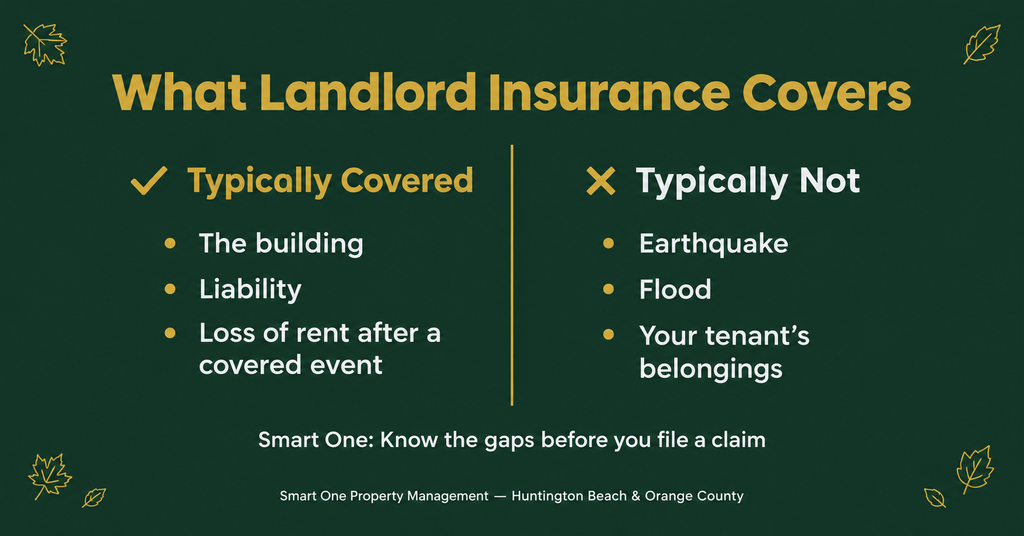
    The building. Dwelling coverage pays to repair or rebuild the structure after a covered event such as fire, wind, or certain types of water damage.

    Other structures. Detached garages, fences, and sheds on the property are usually covered separately from the main building.

    Liability. If a tenant or visitor is injured on the property and you’re found responsible, liability coverage can help with legal costs and settlements.

    Loss of rental income. If a covered event makes the unit uninhabitable, this coverage can replace rent you’d otherwise have collected while repairs are underway. The key phrase is covered event: the coverage only applies when the cause of the damage is itself covered by the policy.

    Your own property. Appliances or furnishings you supply to the unit are typically covered, subject to policy limits.

    What it typically doesn’t cover

    Your tenant’s belongings. A landlord policy protects what you own, not what your tenant owns. Their possessions are covered only by their own renters insurance. Many landlords require tenants to carry a policy in the lease, though it’s worth confirming the details with an attorney.

    Earthquake. This is the big one in California. Standard policies exclude earthquake damage, and coverage has to be added separately, for example through the California Earthquake Authority or a private carrier. Earthquake policies commonly carry deductibles set as a percentage of the dwelling limit, often in the range of 10% to 25%, rather than a flat dollar amount. One nuance: a fire that results from an earthquake is generally still covered under a fire policy, though the shaking damage itself is not.

    Flood. Also excluded from standard policies. It requires its own policy, through the National Flood Insurance Program or a private insurer.

    Wear, tear, and neglect. Insurance covers sudden and accidental damage, not the gradual aging of a roof or plumbing, or problems that come from deferred maintenance.

    Some tenant-related losses. Coverage for damage or theft involving tenants varies a lot between policies, and so does coverage for unpaid rent. These are areas where reading the actual policy language matters more than any general rule.

    Fire and wildfire risk in California

    Fire is a core covered peril on most landlord policies, but in California, whether you can get and keep that coverage has become its own question. In recent years, many insurers have limited new policies or declined to renew existing ones in areas with higher wildfire risk, and owners in those areas have sometimes had to look elsewhere for coverage.

    One option is the California FAIR Plan, the state’s insurer of last resort. Its dwelling policy is generally limited to fire-related perils, such as fire, lightning, internal explosion, and smoke, and it typically doesn’t include liability coverage or other protections found in a full landlord policy. Owners who end up on the FAIR Plan often pair it with a separate “difference in conditions” (DIC) policy or a standalone liability policy to fill those gaps.

    Because this area is changing quickly, and because rules and eligibility for rental properties can differ from those for owner-occupied homes, it’s worth asking your agent two specific questions: whether your property’s coverage could be affected by its location, and whether loss of rental income would still be covered if a fire made the unit uninhabitable under the policy you have, or might end up with. You can also check current rules directly with the California Department of Insurance.

    Why the gaps matter

    Most of the surprises tend to come from the same few places: earthquake and flood assumed to be covered when they aren’t, loss-of-rent coverage that doesn’t apply because the underlying cause isn’t covered, and tenants who skipped renters insurance and then look to the owner after a loss. A short conversation with an insurance agent about your specific property and location, before something happens, costs far less than discovering the gap afterward.

    The takeaway

    Landlord insurance is built to protect your investment, not to cover everything that can go wrong with it. Know what’s included, know what isn’t, and decide deliberately which gaps to close with additional coverage and which risks to accept.

    This post is general information, not insurance or legal advice. Policies vary by carrier and state, so review your own policy and talk with a licensed insurance professional.

    Want help making sure your rental is set up with the right protections and lease terms? Reach out to Smart One Property Management.

    Sources: Steadily, What Does Landlord Insurance Not Cover?; Inszone Insurance, California Landlord Insurance Guide; Schneiderman Insurance, California Earthquake Insurance Coverage.

  • The Down Payment Gap: What First-Time Buyers Have vs. What They Need

    Home prices and mortgage rates get most of the attention when people talk about affordability. But for many first-time buyers, the obstacle comes earlier: the cash needed just to get to the closing table. Looking at the first-time homebuyer down payment next to what typical young households actually hold in savings shows how wide that gap can be.

    What first-time buyers actually put down

    According to the National Association of Realtors’ most recent buyer profile, the median first-time buyer put down 10% of the purchase price, the highest share since 1989, compared with 23% for repeat buyers. Those aren’t the minimums. Loan programs allow far less: FHA loans require as little as 3.5% down with a qualifying credit score, some conventional programs allow 3%, and VA and USDA loans can require nothing. But buyers who can put more down often do, partly to strengthen offers and lower their monthly payment.

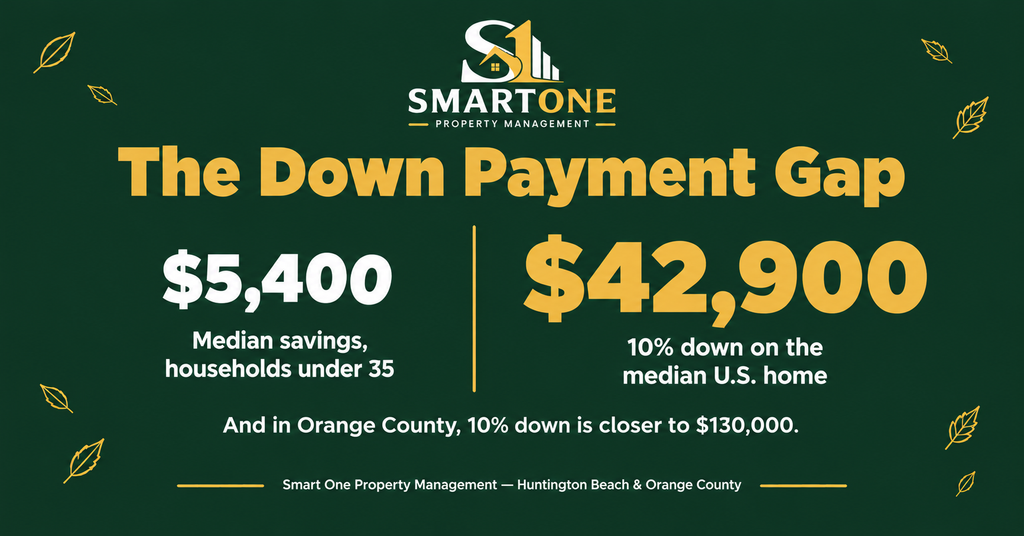
    Applied to a national median existing-home price of about $429,100, a 10% down payment comes to roughly $42,900. A 3.5% FHA down payment is about $15,000. And that’s before closing costs, moving costs, and the cash reserves lenders like to see.

    What young households have saved

    The best publicly available benchmark comes from the Federal Reserve’s Survey of Consumer Finances. In its most recent complete survey (2022), households headed by someone under 35 had a median balance of about $5,400 in checking, savings, and money-market accounts, with an average closer to $20,500. The gap between median and average shows how unevenly savings are distributed, with a smaller number of households holding much more.

    Two cautions apply. That figure covers all households under 35, not only those planning to buy, and it’s dated, so today’s numbers may differ. It also leaves out money held in retirement or investment accounts, and gifts or loans from family, which many first-time buyers rely on. A recent survey cited by U.S. News found that 59% of buyers used personal savings, while more than one in five prospective buyers said they planned to tap retirement accounts to help fund a down payment.

    Even with those limits, the comparison is stark: a typical young household’s liquid savings are a fraction of even a 10% down payment.

    Orange County makes the math harder

    As we covered in our starter home post, Orange County’s median home price is well above $1 million. Using a round $1.3 million for illustration, a 3.5% down payment is about $45,500, a 10% down payment is about $130,000, and a 20% down payment is about $260,000. Those figures are illustrative and vary by property and loan, but they show why so many local buyers are priced out even when they have solid incomes and good credit.

    What it means for rental owners

    When saving for a down payment takes years, many would-be buyers stay renters in the meantime. It’s one more structural reason, alongside high rates and the record number of young adults living with their parents, that rental demand tends to stay durable even when the for-sale market is slow. Rising rents also make saving harder, which can stretch that timeline further.

    For owners, the takeaway is the same as in our earlier posts: pricing accurately and keeping units well-maintained matters, because demand from long-term renters isn’t going away soon.

    Where help exists

    Down payment assistance programs exist at the state and local level, including through the California Housing Finance Agency, and eligibility rules change, so buyers should check current requirements directly.

    This post is general information, not financial advice. Talk with a licensed mortgage professional about your specific situation.

    Own a rental and want to understand how buyer affordability affects your local demand? Reach out to Smart One Property Management.

    Sources: Experian, Average Savings by Age (citing the Federal Reserve’s Survey of Consumer Finances); U.S. News, The Price of Entry May Be Dropping for Prospective Homebuyers; Motley Fool, The Median Down Payment on a Home.

  • Financing Investment Property: Conventional, DSCR, and Portfolio Loans Compared

    How you finance a rental can change its returns as much as which property you buy. The same house can look like a great deal or a mediocre one depending on the loan behind it. Here’s how the three most common types of investment property loans compare, and who each tends to fit.

    Conventional investment loans

    A conventional loan is the standard mortgage, backed or purchased by Fannie Mae or Freddie Mac. For investment property, it typically requires a larger down payment than a primary residence, generally somewhere in the 15% to 25% range depending on the property type and lender, along with solid credit and cash reserves.

    How you qualify: Mainly on your personal finances: income, credit, and debt-to-income ratio. Lenders verify income with tax returns and pay stubs.

    The tradeoffs: Conventional loans usually offer the lowest rates of the three, but they cap how many financed properties you can hold (generally around ten), and the paperwork can be heavy for self-employed investors or those with complicated tax returns.

    DSCR loans

    DSCR stands for debt service coverage ratio: the property’s rental income divided by its debt payments. A DSCR loan qualifies you largely on the property’s cash flow rather than your personal income. Many lenders want a DSCR of at least 1.0, meaning the rent roughly covers the payment, with better pricing often available at 1.20 to 1.25.

    How you qualify: Mostly on the property’s income. No tax returns or pay stubs are typically required, and loans can often be closed in an LLC.

    The tradeoffs: Expect a down payment of roughly 20% to 25%, rates that generally run about half a point to a point and a half above comparable conventional investment loans, and in many cases a prepayment penalty that steps down over the first few years. These loans tend to suit investors whose income is hard to document or who’ve outgrown conventional limits.

    Portfolio loans

    A portfolio loan is one a lender keeps on its own books rather than selling to Fannie Mae or Freddie Mac, which means the lender sets its own rules. Community banks, credit unions, and local lenders are common sources.

    How you qualify: It varies by lender, which is the point. Portfolio lenders can sometimes accommodate situations conventional guidelines don’t, such as unusual properties, mixed-use buildings, or borrowers with many existing mortgages.

    The tradeoffs: Terms differ widely, and may include adjustable rates, shorter terms, or balloon payments. The best way to learn what’s available is to ask local lenders directly.

    How to choose

    If you have strong, easily documented income and are financing a handful of properties, conventional is usually the cheapest route. If your income is hard to verify, or you’re scaling past conventional limits, DSCR loans fill that gap at a higher cost. If your situation doesn’t fit standard boxes, a portfolio lender may be worth a conversation.

    Whichever route you take, run the full numbers on the actual loan terms, not an assumption. Interest rate, down payment, and prepayment terms all flow into your cash-on-cash return, and our walkthrough on how to run the numbers before buying a rental shows where financing fits in the analysis. It also connects back to understanding your goals, since the right loan depends on what you’re trying to build.

    This post is for general informational purposes only and is not financial or lending advice. Loan terms vary by lender and change frequently, so speak with a licensed mortgage professional about your specific situation.

    Working through financing for a rental purchase and want a second opinion on the numbers? Reach out to Smart One.

    Sources: Lending One, DSCR Loans: Requirements, Rates, and How to Qualify (2026 Guide); Lending One, DSCR Loan vs. Conventional Loan.

  • Turnkey vs. Value-Add Properties: Which Is Right for You?

    Two investors can both want a rental property and end up buying completely opposite things. One pays full price for a renovated, tenant-ready home and starts collecting rent within weeks. The other buys something dated and neglected at a discount, puts in months of work, and aims to come out ahead on the other side. That’s the core of turnkey vs. value-add properties: a trade between convenience and potential upside.

    What a turnkey property is

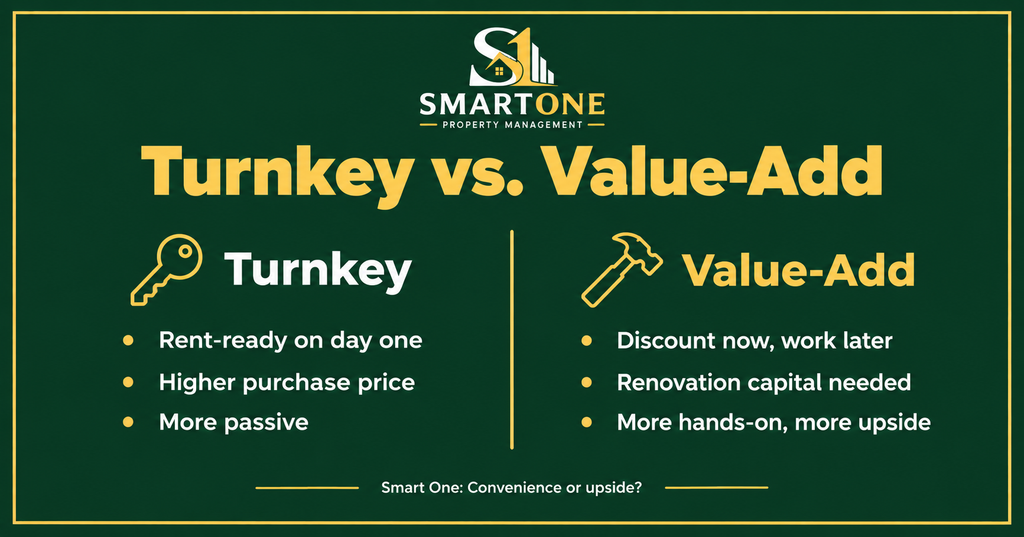
    A turnkey property is move-in or rent-ready on day one. It’s typically renovated, in good condition, and often already leased to a tenant, so cash flow can begin almost immediately after closing. You pay for that convenience: turnkey properties generally sell at or near market value, since the seller (or a turnkey provider) has already done the work and priced it in.

    What a value-add property is

    A value-add property has room to be improved: dated finishes, deferred maintenance, below-market rents, poor management, or a vacant unit that could be leased. You buy it for less than its potential value, invest in improvements or better operations, and aim to increase both rental income and property value. The upside can be significant, but so can the risk if the work runs over budget or over schedule.

    How they compare

    Upfront cost. Turnkey costs more to buy but requires little additional capital. Value-add costs less to buy but requires renovation funds on top, plus carrying costs while the work is underway.

    Time to income. Turnkey can generate rent almost immediately. Value-add typically means months of vacancy or reduced income during renovation before the property performs the way you underwrote it.

    Risk profile. Turnkey risk is mostly about overpaying or trusting a seller’s claims about condition and rent. Value-add risk is about execution: cost overruns, permitting delays, contractor problems, and the chance your projected post-renovation rents don’t materialize.

    Hands-on effort. Turnkey is far more passive. Value-add demands project management, contractor oversight, and quick decisions, whether you do that yourself or hire it out.

    Return potential. Value-add offers more room to create equity through forced appreciation, since you’re improving the asset yourself. Turnkey returns tend to be steadier but more modest, because less value is left on the table for you to capture.

    Financing matters here

    Turnkey properties usually fit standard financing, since the property is in good condition at purchase. Value-add deals often need creative or specialized financing to cover the renovation, such as renovation loans, cash reserves, or short-term bridge financing. If you plan to live in the property, the FHA 203(k) loan is one option that rolls purchase and renovation costs into a single mortgage.

    Which one fits you

    This comes back to understanding your goals before making a purchase decision. A busy investor who wants income soon, minimal involvement, and predictable operations is usually better served by turnkey. An investor with renovation experience, available capital, time to manage a project, and a higher tolerance for risk may find value-add produces better returns. Whichever you choose, run the numbers on the real post-renovation scenario, not the best case, before you make an offer.

    Weighing a turnkey purchase against a value-add project and want a second opinion on the numbers? Reach out to Smart One.

  • The FHA 203(k) Loan: An Underused Way to Buy a Home That Needs Work

    Most buyers looking at a dated or outdated property face the same math problem: the purchase price might work, but where does the renovation money come from? The FHA 203(k) loan solves exactly that by rolling the purchase price and renovation costs into a single mortgage — and a set of 2024 updates made it meaningfully more usable than it used to be. It’s still one of the more underused tools available to buyers willing to take on a fixer-upper.

    How it actually works

    A 203(k) loan finances the purchase (or refinance) of a property and the cost of renovating it in one loan, with one closing, rather than requiring a separate purchase mortgage and a renovation loan or cash reserve. There are two versions: the Limited 203(k), for smaller cosmetic and repair projects, and the Standard 203(k), for larger-scale renovations, including structural work. Funds for the renovation are held in an escrow-like account and released in draws as work is completed, typically overseen by a HUD consultant on larger Standard projects.

    One important eligibility detail

    A 203(k) loan is an FHA product, which means it generally requires the borrower to occupy the property as a primary residence — it’s not designed for a pure investment purchase by a non-occupying buyer. It does extend to properties with up to four units, as long as the buyer lives in one of them, which makes it a genuine option for a “house hack” strategy: buy a multi-unit property, live in one unit, rent out the others, and finance the renovation of the whole property in the process.

    What changed in 2024

    HUD’s Mortgagee Letter 2024-13, effective for FHA case numbers assigned on or after November 4, 2024, made several changes that directly addressed the program’s biggest practical limitations:

    The Limited 203(k) cap more than doubled — from $35,000 to $75,000 in total rehabilitation costs, with HUD now reviewing that limit annually to keep pace with inflation. That single change made the Limited program usable for far more realistic renovation scopes than the old $35,000 ceiling allowed.

    Renovation timelines got longer. The Standard 203(k) completion window extended to 12 months, and the Limited 203(k) to 9 months — both up from a previous 6-month window that often didn’t leave enough time for permitting delays, contractor scheduling, or material availability.

    Consultant fees were updated for the first time since 1995, now ranging from $1,000 for smaller projects up to $2,000 or 1% of the total mortgage for larger ones — and those fees can now be financed into the loan itself, reducing upfront out-of-pocket cost.

    The post-closing move-in window for Limited 203(k) borrowers extended from 15 to 30 days, giving buyers more realistic breathing room before needing to occupy the property.

    Why this is worth knowing about in Orange County

    Orange County’s more accessible entry-point cities — the ones we covered in our starter homes post, like Santa Ana, Garden Grove, and Buena Park — tend to have older housing stock that often needs work to compete with newer construction. A 203(k) loan is one of the more realistic tools for a buyer priced out of move-in-ready inventory to still get into a home, with renovation financing built directly into the purchase rather than needing separate cash on hand.

    Curious whether a 203(k) loan or a similar renovation financing strategy fits your situation? Reach out to Smart One.

    Sources: Consumer Finance Monitor, FHA Finalizes Enhancements to its 203(k) Rehabilitation Mortgage Loan Program; HUD.com, FHA Updates 203(k) Rehabilitation Loan Policy.

  • 1031 Exchanges Explained: Deferring Capital Gains on Investment Property

    Selling an investment property usually means a capital gains tax bill. A 1031 exchange — named for Section 1031 of the tax code — lets investors defer that tax by rolling the proceeds into another qualifying property instead of cashing out. It’s one of the most powerful tools available to real estate investors, and also one of the easiest to get wrong on timing alone.

    The basic idea

    Instead of selling a property and paying capital gains tax on the profit, an investor sells and reinvests the proceeds into a new “like-kind” property, deferring the tax until — or unless — they eventually sell without doing another exchange. “Like-kind” is broader than it sounds: it generally covers any real property held for investment or business use, so a duplex can be exchanged for raw land, or a single-family rental for a share in a larger commercial property, as long as both sides of the trade are real estate held for investment purposes rather than personal use.

    The two deadlines that make or break the exchange

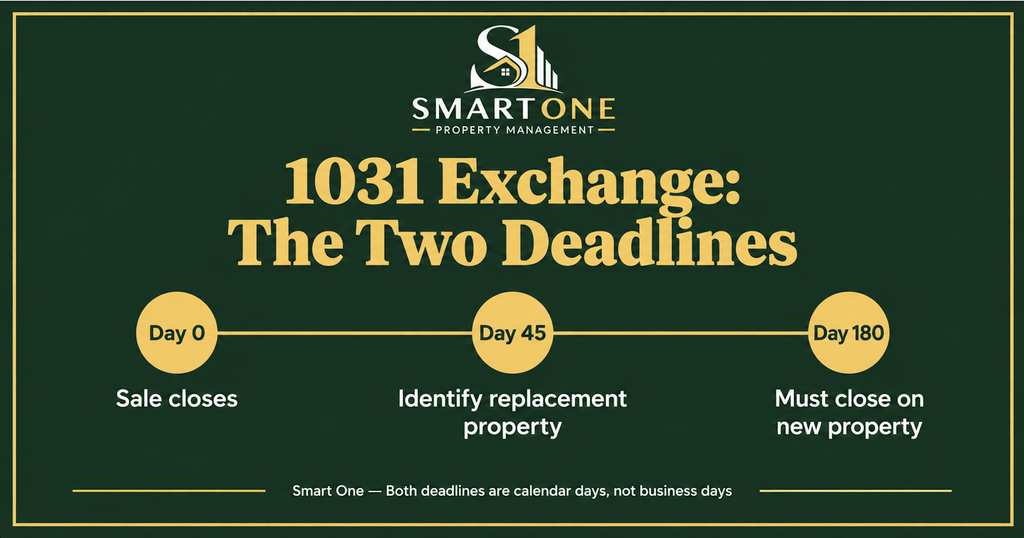
    This is where most 1031 exchanges actually go wrong — not the concept, but the calendar. From the day the relinquished property’s sale closes, an investor has exactly 45 calendar days to formally identify potential replacement properties in writing, and 180 calendar days total to close on the purchase. Both deadlines run simultaneously from the same closing date, count calendar days rather than business days, and generally cannot be extended for financing delays, inspection issues, or anything else — though federally declared disaster areas have sometimes triggered automatic extensions in recent years. Missing either deadline disqualifies the exchange entirely.

    The qualified intermediary requirement

    An investor can’t simply hold the sale proceeds themselves between closing the sale and buying the replacement — doing so disqualifies the exchange. A qualified intermediary (QI) must hold the funds, prepare the exchange documentation, and handle the transfer at closing. The QI also can’t be just anyone: your own attorney, CPA, or real estate agent who has represented you within the prior two years is disqualified from serving in that role.

    What can turn part of the exchange taxable (“boot”)

    If an investor receives any cash, has debt reduced without replacing it with equivalent new debt, or ends up with non-like-kind property mixed into the deal, that portion — called “boot” — becomes taxable even within an otherwise valid exchange. A clean, fully deferred exchange generally means reinvesting all the proceeds and matching or exceeding the debt on the property being sold.

    Why investors use this strategy

    A 1031 exchange lets an investor upgrade, consolidate, or diversify a portfolio without losing capital to a tax bill along the way — trading a management-intensive property for a more passive one, or several smaller properties for one larger asset, while keeping the full value of the sale working for them. This is exactly the kind of goal-driven strategy we covered in our post on understanding an investor’s goals before making a recommendation — a 1031 exchange isn’t the right move for every seller, but for an investor specifically optimizing around deferring tax and staying invested in real estate, it’s often the centerpiece of the plan.

    The takeaway

    A 1031 exchange can be one of the most effective tools in a real estate investor’s toolkit, but the deadlines are unforgiving and the rules around intermediaries and like-kind property are specific enough that professional guidance matters. This post is for general informational purposes only and is not tax or legal advice — 1031 exchanges involve real deadlines and real consequences for getting the details wrong, so work with a qualified intermediary and a CPA before relying on this strategy for a real transaction. The IRS’s own guidance on like-kind exchanges is a good starting reference point.

    Considering a 1031 exchange and want to talk through the timeline? Reach out to Smart One.