How you finance a rental can change its returns as much as which property you buy. The same house can look like a great deal or a mediocre one depending on the loan behind it. Here’s how the three most common types of investment property loans compare, and who each tends to fit.
Conventional investment loans
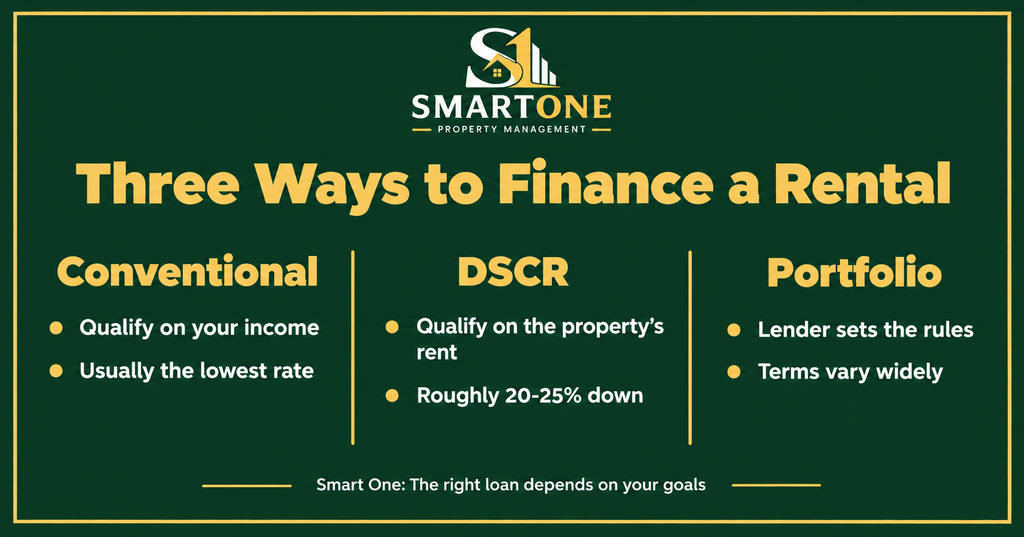
A conventional loan is the standard mortgage, backed or purchased by Fannie Mae or Freddie Mac. For investment property, it typically requires a larger down payment than a primary residence, generally somewhere in the 15% to 25% range depending on the property type and lender, along with solid credit and cash reserves.
How you qualify: Mainly on your personal finances: income, credit, and debt-to-income ratio. Lenders verify income with tax returns and pay stubs.
The tradeoffs: Conventional loans usually offer the lowest rates of the three, but they cap how many financed properties you can hold (generally around ten), and the paperwork can be heavy for self-employed investors or those with complicated tax returns.
DSCR loans
DSCR stands for debt service coverage ratio: the property’s rental income divided by its debt payments. A DSCR loan qualifies you largely on the property’s cash flow rather than your personal income. Many lenders want a DSCR of at least 1.0, meaning the rent roughly covers the payment, with better pricing often available at 1.20 to 1.25.
How you qualify: Mostly on the property’s income. No tax returns or pay stubs are typically required, and loans can often be closed in an LLC.
The tradeoffs: Expect a down payment of roughly 20% to 25%, rates that generally run about half a point to a point and a half above comparable conventional investment loans, and in many cases a prepayment penalty that steps down over the first few years. These loans tend to suit investors whose income is hard to document or who’ve outgrown conventional limits.
Portfolio loans
A portfolio loan is one a lender keeps on its own books rather than selling to Fannie Mae or Freddie Mac, which means the lender sets its own rules. Community banks, credit unions, and local lenders are common sources.
How you qualify: It varies by lender, which is the point. Portfolio lenders can sometimes accommodate situations conventional guidelines don’t, such as unusual properties, mixed-use buildings, or borrowers with many existing mortgages.
The tradeoffs: Terms differ widely, and may include adjustable rates, shorter terms, or balloon payments. The best way to learn what’s available is to ask local lenders directly.
How to choose
If you have strong, easily documented income and are financing a handful of properties, conventional is usually the cheapest route. If your income is hard to verify, or you’re scaling past conventional limits, DSCR loans fill that gap at a higher cost. If your situation doesn’t fit standard boxes, a portfolio lender may be worth a conversation.
Whichever route you take, run the full numbers on the actual loan terms, not an assumption. Interest rate, down payment, and prepayment terms all flow into your cash-on-cash return, and our walkthrough on how to run the numbers before buying a rental shows where financing fits in the analysis. It also connects back to understanding your goals, since the right loan depends on what you’re trying to build.
This post is for general informational purposes only and is not financial or lending advice. Loan terms vary by lender and change frequently, so speak with a licensed mortgage professional about your specific situation.
Working through financing for a rental purchase and want a second opinion on the numbers? Reach out to Smart One.
Sources: Lending One, DSCR Loans: Requirements, Rates, and How to Qualify (2026 Guide); Lending One, DSCR Loan vs. Conventional Loan.