Author: smartonepropertymanagement

  • Pet Policies: How to Protect Your Property and Stay Compliant

    A pet policy sounds like a simple property decision — allow pets or don’t, charge a fee or don’t. In practice, it’s one of the areas where self-managing owners run into the most legal risk, mainly because of one distinction that gets confused constantly: the difference between a pet and an assistance animal.

    Pets vs. assistance animals: not the same thing, legally

    A pet is a pet. An assistance animal — which includes both service animals and emotional support animals (ESAs) — is legally treated as a reasonable accommodation under fair housing law, not a pet at all. That distinction has real consequences: landlords cannot charge pet rent, a pet deposit, or any additional fee for a legitimate assistance animal, cannot apply breed, size, or number restrictions to one, and cannot deny one under a blanket “no pets” policy. California provides especially strong protections here through the federal Fair Housing Act, the state’s Fair Employment and Housing Act, and Assembly Bill 468, which as of 2026 requires ESA letters to come from a licensed mental health professional following a genuine 30-day patient-provider relationship — a meaningful guardrail against the instant-ESA-letter sites that circulated in past years.

    Denying a legitimate assistance animal is only allowed in narrow circumstances — the specific animal poses a documented safety or health threat, the tenant won’t provide requested (limited) documentation, or the accommodation would fundamentally alter the housing. Outside those situations, a no-pets policy simply doesn’t apply.

    What you can actually control for true pets

    For pets that aren’t assistance animals, owners have real flexibility: reasonable breed or size restrictions, a pet interview or meet-and-greet before approval, a pet count limit, and a written pet addendum spelling out expectations — leash rules, cleanup responsibility, noise, and what happens if damage occurs.

    The deposit cap changes what you can charge

    This is where a lot of existing pet policies are now out of date. Under California’s AB 12, effective since mid-2024, most landlords can collect no more than one month’s rent as a total security deposit — and that cap includes everything, pet deposits included. You can’t charge a full month’s security deposit and then stack a separate pet deposit on top; a “small landlord” (someone who owns two or fewer rental properties totaling four or fewer units) can collect up to two months, but that’s the outer limit either way. Pet rent, a recurring monthly charge rather than a deposit, is a separate, still-available tool for true pets, since it isn’t a deposit and falls outside the AB 12 cap.

    Put it in writing

    Whatever your policy is, document it clearly in the lease and a pet addendum, and apply it the same way to every applicant. Inconsistent enforcement is exactly the kind of lease violation mistake that creates fair housing exposure even when unintentional.

    This post is for general informational purposes only and is not legal advice — assistance animal accommodations and deposit rules carry real compliance risk, so consult an attorney or your property manager before finalizing a pet policy or responding to an accommodation request.

    How Smart One handles this

    At Smart One, every pet policy and assistance animal request is handled through a consistent, documented process — protecting owners from fair housing exposure while still giving true pet policies real teeth.

    Want help reviewing or setting up a compliant pet policy for your property? Reach out to Smart One Property Management.
  • 1031 Exchanges Explained: Deferring Capital Gains on Investment Property

    Selling an investment property usually means a capital gains tax bill. A 1031 exchange — named for Section 1031 of the tax code — lets investors defer that tax by rolling the proceeds into another qualifying property instead of cashing out. It’s one of the most powerful tools available to real estate investors, and also one of the easiest to get wrong on timing alone.

    The basic idea

    Instead of selling a property and paying capital gains tax on the profit, an investor sells and reinvests the proceeds into a new “like-kind” property, deferring the tax until — or unless — they eventually sell without doing another exchange. “Like-kind” is broader than it sounds: it generally covers any real property held for investment or business use, so a duplex can be exchanged for raw land, or a single-family rental for a share in a larger commercial property, as long as both sides of the trade are real estate held for investment purposes rather than personal use.

    The two deadlines that make or break the exchange

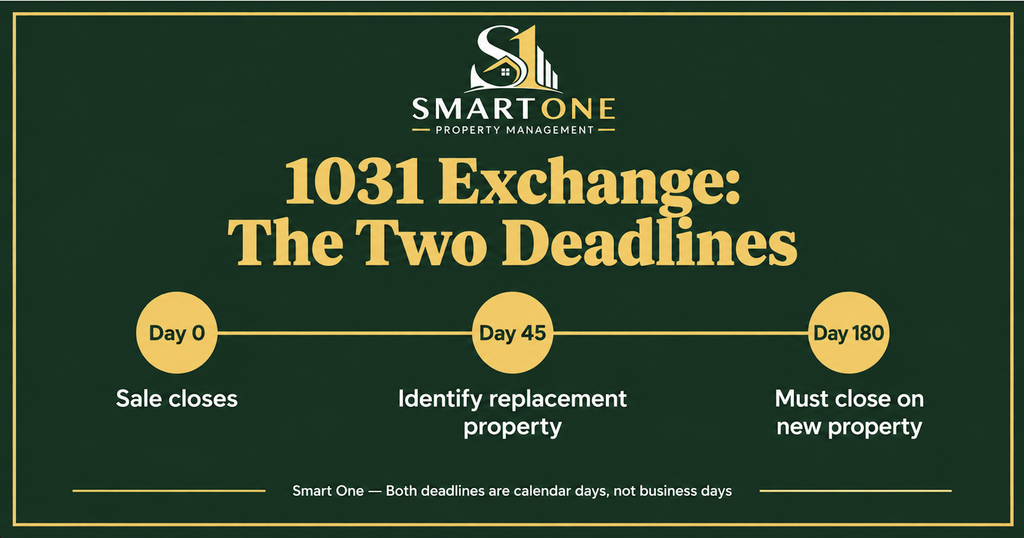
    This is where most 1031 exchanges actually go wrong — not the concept, but the calendar. From the day the relinquished property’s sale closes, an investor has exactly 45 calendar days to formally identify potential replacement properties in writing, and 180 calendar days total to close on the purchase. Both deadlines run simultaneously from the same closing date, count calendar days rather than business days, and generally cannot be extended for financing delays, inspection issues, or anything else — though federally declared disaster areas have sometimes triggered automatic extensions in recent years. Missing either deadline disqualifies the exchange entirely.

    The qualified intermediary requirement

    An investor can’t simply hold the sale proceeds themselves between closing the sale and buying the replacement — doing so disqualifies the exchange. A qualified intermediary (QI) must hold the funds, prepare the exchange documentation, and handle the transfer at closing. The QI also can’t be just anyone: your own attorney, CPA, or real estate agent who has represented you within the prior two years is disqualified from serving in that role.

    What can turn part of the exchange taxable (“boot”)

    If an investor receives any cash, has debt reduced without replacing it with equivalent new debt, or ends up with non-like-kind property mixed into the deal, that portion — called “boot” — becomes taxable even within an otherwise valid exchange. A clean, fully deferred exchange generally means reinvesting all the proceeds and matching or exceeding the debt on the property being sold.

    Why investors use this strategy

    A 1031 exchange lets an investor upgrade, consolidate, or diversify a portfolio without losing capital to a tax bill along the way — trading a management-intensive property for a more passive one, or several smaller properties for one larger asset, while keeping the full value of the sale working for them. This is exactly the kind of goal-driven strategy we covered in our post on understanding an investor’s goals before making a recommendation — a 1031 exchange isn’t the right move for every seller, but for an investor specifically optimizing around deferring tax and staying invested in real estate, it’s often the centerpiece of the plan.

    The takeaway

    A 1031 exchange can be one of the most effective tools in a real estate investor’s toolkit, but the deadlines are unforgiving and the rules around intermediaries and like-kind property are specific enough that professional guidance matters. This post is for general informational purposes only and is not tax or legal advice — 1031 exchanges involve real deadlines and real consequences for getting the details wrong, so work with a qualified intermediary and a CPA before relying on this strategy for a real transaction. The IRS’s own guidance on like-kind exchanges is a good starting reference point.

    Considering a 1031 exchange and want to talk through the timeline? Reach out to Smart One.

  • What Happens When a Tenant Stops Paying Rent?

    Rent doesn’t show up on the first, and now what? What happens when a tenant stops paying rent is one of the most stressful situations a self-managing owner can face — partly because of the lost income, and partly because California gives landlords a specific, legally required process to follow, with real consequences for skipping steps.

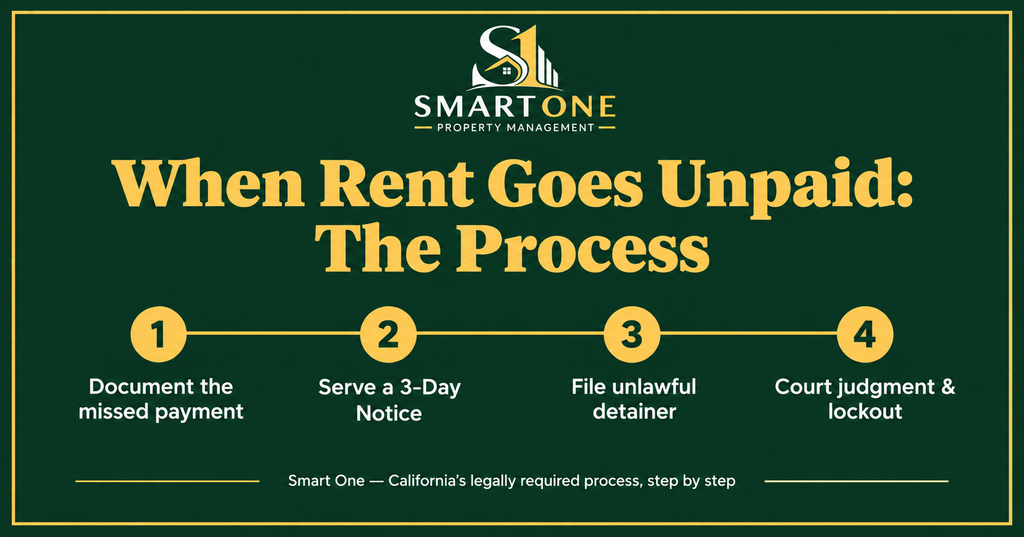
    Step 1: Confirm and document

    Before anything else, confirm the payment genuinely didn’t arrive — a bank delay or a processing error happens more often than people expect — and document the missed payment with a date and amount. This record matters if the situation escalates.

    Step 2: Serve a 3-Day Notice to Pay Rent or Quit

    If rent is genuinely unpaid, the next legally required step is a 3-Day Notice to Pay Rent or Quit. To be valid in California, the notice needs the full legal names of all tenants on the lease, clear instructions for how and where to pay, a specific expiration date, and it must account for the fact that weekends and judicial holidays don’t count toward the three days — so a notice served on a Thursday effectively runs into the following week. The notice can only demand the actual unpaid rent — not late fees, utility charges, or other add-on costs, even if those are also technically owed.

    Step 3: What happens if the tenant pays — or doesn’t

    If the tenant pays the full amount demanded within the notice period, that typically resolves the situation, and the notice is satisfied. If they don’t pay and don’t move out, the next step is filing an unlawful detainer lawsuit in Superior Court — this is the formal legal term for an eviction case.

    Step 4: The unlawful detainer process

    Once filed, the tenant is served with a summons and complaint and has 10 business days to file a written response. If they don’t respond in time, the landlord can request a default judgment. If they do respond, the case proceeds through the court process, which can take additional weeks depending on the court’s schedule and whether the tenant contests it.

    What you can’t do — even if you’re frustrated

    California law is strict on this point: the only lawful way to remove a tenant is a court judgment followed by a sheriff-executed lockout. Changing the locks, shutting off utilities, removing a tenant’s belongings, or any other “self-help” eviction is illegal in California, regardless of how much rent is owed or how clearly the tenant is in the wrong. Taking matters into your own hands can expose you to real liability — including potential damages owed to the tenant — on top of the unpaid rent you were already trying to collect.

    Before you escalate

    Not every missed payment needs to go straight to a formal notice. A tenant with an otherwise solid payment history who’s dealing with a genuine, temporary hardship may be worth a conversation and a documented partial-payment plan before escalating — that’s a business judgment call, not a legal requirement, but it’s often the difference between resolving something quickly and losing a good tenant over one rough month. Whatever you decide, document it in writing either way.

    Why this is where self-managing owners feel the most pressure

    The timelines, notice requirements, and prohibition on self-help eviction are exactly the kind of process a property manager runs routinely rather than learning for the first time under stress. The California Courts Self-Help Center’s eviction guide is a solid starting point for understanding the process, but timing and paperwork mistakes are common even with good information in hand.

    Dealing with a tenant who’s stopped paying and not sure what to do next? Reach out to Smart One Property Management.
    ****Disclaimer: This article is for general informational purposes only and does not constitute legal advice. Laws affecting landlords and tenants change frequently and can vary by city and county. Before taking action based on this information, please consult a licensed attorney regarding your specific situation.

  • Orange County Market Report: Costa Mesa & Cypress

    Next in our city-by-city series: Costa Mesa and Cypress. Both run well above the national rent average, but they get there in different ways — one through a premium coastal-adjacent apartment market, the other through a smaller, more owner-occupied rental pool.

    Costa Mesa: one of the priciest apartment markets in the county

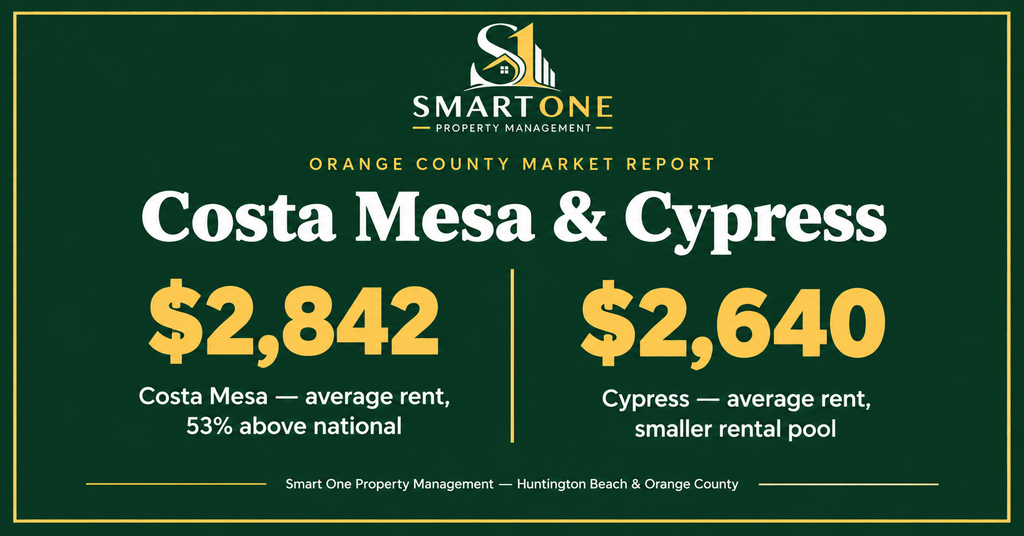
    Costa Mesa’s average apartment rent runs around $2,842, per RentCafe’s 2026 data, with the citywide median across all property types closer to $3,006. Rent here sits roughly 53% above the national average, and 35% of rentals in the city — the largest single share — go for $3,000 or more per month. Two-bedroom units average around $3,181, and three-bedrooms push past $3,500.

    For owners, Costa Mesa is a market where premium pricing is genuinely supported by demand — but it also means a property that’s even slightly overpriced relative to true comparables will be competing directly against a large pool of similarly priced, well-maintained units.

    Cypress: a smaller rental pool with mixed signals

    Cypress tells a more complicated story. Rent estimates vary more here than in most cities we’ve covered — RentCafe puts the average around $2,640 (up modestly year-over-year), while another source shows a notably higher $2,830 average that’s actually down about 10% from a year ago. That kind of divergence usually points to a smaller sample size or a shift in the mix of available units, rather than a single clean trend, so these figures should be treated as more directional than precise for Cypress specifically. One-bedrooms average around $2,311, two-bedrooms around $2,856.

    What’s clearer is the composition of the city itself: only about 32% of Cypress households are renter-occupied, compared to 68% owner-occupied — a notably higher owner-occupied share than most cities in this series so far. That points to a smaller, tighter rental pool overall, which can work in an owner’s favor (less direct competition) but also means fewer comparable listings to price against with confidence.

    What this means if you own in either market

    In Costa Mesa, lean on solid comparables in a genuinely competitive, premium apartment market — the ceiling is real, but so is the competition at that price point. In Cypress, be more cautious about which data source you’re trusting for pricing, and factor in that a smaller rental pool means less room for error if a unit is priced outside what the limited comparable set supports.

    Neither city had reliable vacancy-specific data available in this search; as a directional reference, Orange County’s broader multifamily vacancy rate has been running around 4.0–4.3% in 2026, per the Kidder Mathews data cited in our earlier countywide report.

    Own a rental in Costa Mesa, Cypress, or elsewhere in Orange County and want to know how your property compares to current market data? Reach out to Smart One Property Management.
    Sources: RentCafe, Average Rent in Costa Mesa, CA; RentCafe, Average Rent in Cypress, CA; Zillow Rental Manager, Average Rental Price in Cypress, CA.

  • Starter Homes Are Getting Scarcer Nationally. In Orange County, the Math Is Even Tighter.

    “Starter home” implies something entry-level and attainable. Nationally, that’s increasingly a stretch — and in Orange County, the term barely applies at all.

    The national starter home picture

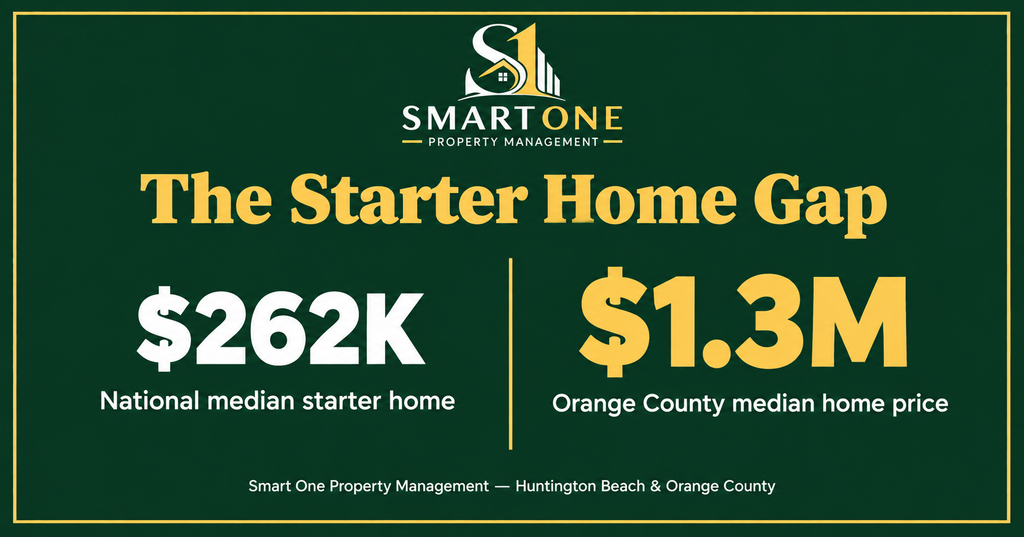
    The median U.S. starter home costs around $262,317 as of 2026, requiring roughly $70,000–$80,000 in household income to afford comfortably, according to Redfin’s data. The good news, such as it is: affordability has been improving slightly faster than the overall market, and the income needed to afford a starter home has been falling since late 2025. The harder truth is inventory — the share of listings that qualify as “starter homes” has dropped from about 70% in 2019 to roughly 55% in 2026. There are simply fewer entry-level homes coming to market than there used to be, even as affordability inches in the right direction.

    Orange County’s version of this problem is much steeper

    Orange County’s median home price has climbed past $1.3 million, more than five times the national starter home figure. Only about 18% of Orange County households can afford a median-priced home in the county, and prices here run roughly 172% above the national average. Inventory tells a similar story: the county is still missing about 26% of the homes that would normally reach the market compared to pre-pandemic (2017–2019) levels — a real improvement from being down 41% in 2023, but still a meaningfully thinner market than buyers saw just a few years ago.

    Where Orange County’s actual entry points are

    “Starter home” in Orange County doesn’t mean cheap — it means relative. Cities like Santa Ana, Stanton, Garden Grove, Buena Park, La Habra, Anaheim, and Westminster consistently fall below the county median, with Anaheim averaging around $920K and Garden Grove around $970K. These cities tend to share a few traits: older housing stock, a higher share of condos and townhomes, and fewer coastal price premiums. For a first-time buyer priced out of Newport Beach or Huntington Beach, these cities are where realistic options actually exist.

    What this means for rental property owners

    When entry-level buyers get squeezed this hard, the effect shows up directly in the rental market. Would-be first-time buyers who can’t clear Orange County’s affordability bar don’t disappear from the housing market — they stay renters for longer, often in the same entry-point cities where they’d otherwise be shopping to buy. That’s a meaningful signal for owners with rental property in Santa Ana, Garden Grove, Buena Park, Anaheim, or similar submarkets: sustained demand from exactly the renter segment least likely to transition to homeownership anytime soon.

    This connects to the pattern we’ve tracked in recent posts on mortgage rates and rental demand — buyers on the sidelines, for whatever reason, tend to become longer-term renters, and Orange County’s starter home math is one more structural reason that dynamic isn’t going away quickly.

    The takeaway

    Nationally, starter homes are scarce but slowly improving. In Orange County, the scarcity is far more extreme, and the “starter” label really only applies in a handful of specific cities rather than the county broadly. For owners, that reinforces where rental demand is likely to stay durable — precisely the cities first-time buyers are being priced out of.

    Own a rental in one of Orange County’s more accessible entry-point cities and want to know how current demand affects your pricing? Reach out to Smart One Property Management.

    Sources: Redfin, Starter Home Market Data Center; Redfin, First-Time Buyers Catch a Break as Affordability Improves; firsttuesday Journal, Orange County Housing Indicators.

  • How to Run the Numbers Before Buying a Rental Property

    The listing photos and the neighborhood can sell you on a property before the numbers ever get a fair look. Knowing how to run the numbers before buying a rental property — in the right order, with realistic assumptions — is what separates a good purchase from an expensive lesson. Here’s a framework to work through before making an offer, not after.

    Step 1: Estimate realistic gross rent

    Start with what the unit will actually rent for, not what you hope it will rent for. Pull comparable active listings for similar properties nearby — same bedroom count, similar condition, similar location — and be conservative. Overestimating rent is the single most common way new investors make a mediocre deal look great on paper.

    Step 2: Account for every operating expense, not just the obvious ones

    Property taxes, insurance, and any HOA dues are easy to find and easy to remember. The expenses that trip people up are the ones that don’t show up on a listing: a maintenance reserve (commonly estimated around 1% of the property’s value per year, though older properties often run higher), a vacancy reserve (budgeting for the property sitting empty part of the year, even in a strong market), and property management, typically 8–12% of collected rent if you won’t be self-managing. Skipping any of these doesn’t make the cost disappear — it just means you’ll discover it after closing instead of before.

    Step 3: Calculate net operating income (NOI)

    NOI is gross rental income minus operating expenses — everything from Step 2 — but before financing costs. This number is what cap rate is built on, and it’s the cleanest way to evaluate a property’s performance independent of how you’re paying for it.

    Step 4: Layer in financing to find actual cash flow

    Subtract your mortgage payment (principal and interest) from NOI, and what’s left is your actual monthly cash flow. This is where financing terms matter enormously — a larger down payment lowers your monthly debt service and increases cash flow, while a smaller down payment does the opposite but ties up less of your capital. Neither is automatically right; it depends on what you’re optimizing for.

    Step 5: Run cap rate and cash-on-cash return

    Once you have NOI and actual cash flow, you can calculate both cap rate (NOI ÷ purchase price) and cash-on-cash return (annual cash flow ÷ total cash invested) — we walked through both of these, including a worked example, in our cap rate vs. cash-on-cash return post. Running both numbers, rather than just one, gives you a fuller picture of how the property performs both on its own and specifically for your financing situation.

    A quick gut-check (with a caveat)

    Some investors use the “1% rule” as a fast first screen — monthly rent should be at least 1% of the purchase price — to quickly rule properties in or out before doing full math. It’s a useful filter for narrowing a long list, but it’s a rough heuristic, not a substitute for the actual calculation above; plenty of solid deals fall outside it, especially in markets with strong appreciation, and plenty of properties that pass it don’t hold up once real expenses are factored in.

    Why this matters more than the listing price

    Two properties at the same purchase price can perform completely differently once real numbers are run — and the property that “feels” like the better deal on a walkthrough isn’t always the one that actually performs better on paper. Running the full framework before making an offer, rather than after, is what keeps a decision based on math instead of momentum.

    Working through the numbers on a potential purchase and want a second opinion? Reach out to Smart One.

  • Single-Family vs. Multifamily: Which Fits Your Investment Strategy?

    Should I buy a single-family rental or a multifamily property?” is one of the most common questions new investors ask — and like most investing questions, the honest answer is that it depends on what you’re actually trying to accomplish. Single-family vs. multifamily investing isn’t a question of which is objectively better. It’s a question of which fits your capital, your risk tolerance, and how hands-on you want to be.

    Financing looks completely different

    This is where the two paths diverge most concretely. Properties with one to four units qualify for conventional residential financing through Fannie Mae and Freddie Mac — the same type of loan used for a primary residence, with lower down payment options and more accessible underwriting. Once a property hits five or more units, it moves into commercial and multifamily lending territory, per Fannie Mae’s property eligibility guidelines — different qualification standards, typically larger down payments, and underwriting based more heavily on the property’s own income (NOI and debt service coverage) than on the borrower’s personal financials alone.

    That threshold has real practical consequences: a duplex, triplex, or fourplex is a meaningfully easier entry point for a first-time investor than a true multifamily property, even though both technically involve “multiple units.”

    Risk is distributed differently

    A single-family rental is binary — it’s either fully rented or fully vacant, and 100% of the income stops the day a tenant moves out. A multifamily property spreads that risk across units: if one unit out of eight goes vacant, you’re still collecting rent on the other seven. For investors prioritizing income stability, that diversification is one of multifamily’s biggest structural advantages.

    The tradeoff is concentration of a different kind — a single-family portfolio can be spread across different neighborhoods or even different cities, while a multifamily property concentrates your capital in one location, one building, and one set of local market conditions.

    The buyer pool at resale is different too

    Single-family homes sell into the largest possible buyer pool — both investors and owner-occupants shopping for a primary residence, which tends to support liquidity and resale value. Multifamily properties sell almost exclusively to other investors, a smaller pool evaluating the deal on cap rate and cash flow rather than emotional appeal. That’s not necessarily a disadvantage, but it does mean exit timing and pricing work differently.

    Management complexity scales differently too

    A single-family rental is a manageable, contained responsibility — one roof, one tenant relationship, one set of systems. A multifamily property multiplies the operational complexity: more tenants, more turnover events, more shared systems and common areas to maintain, but also more efficiency per unit, since a property manager or maintenance vendor handling eight units in one building is more efficient than the same person managing eight scattered single-family homes.

    Which one fits your strategy

    This connects directly to understanding your goals before making a purchase decision. An investor prioritizing simplicity, broad resale liquidity, and a lower entry cost is usually better served starting with single-family. An investor prioritizing income diversification, operational efficiency at scale, and willing to take on commercial financing and more complex management is a better fit for multifamily. Neither is the “smarter” investment in the abstract — the right one depends entirely on the strategy you’re actually running.

    Weighing single-family against multifamily for your next purchase? Reach out to Smart One.

  • Mortgage Rates Just Hit a 2026 High. Here’s What That’s Doing to Demand.

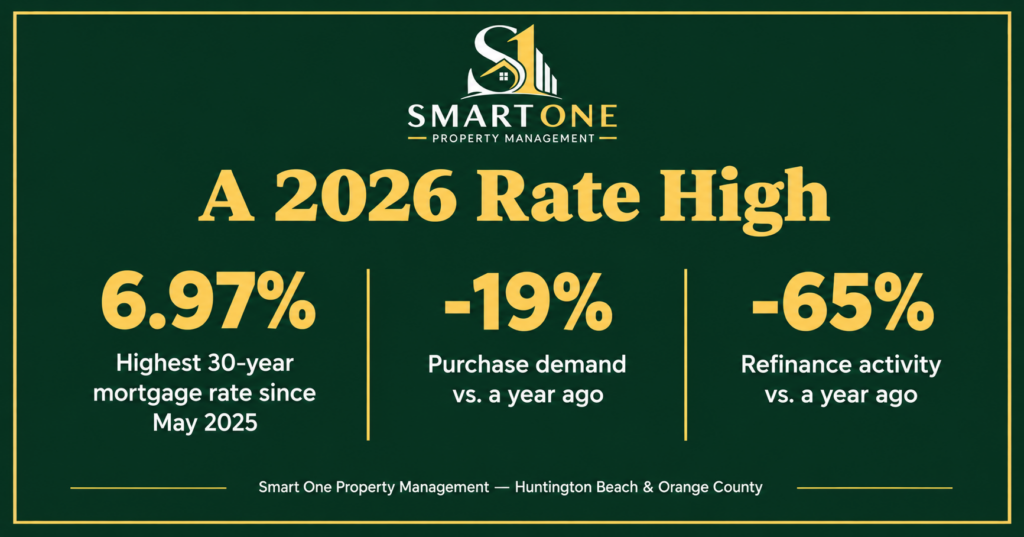
    Mortgage rates climbed to 6.97% in mid-September — the highest level since May 2025 — and the latest data from the Mortgage Bankers Association shows exactly what that’s doing to demand. Total mortgage application volume fell 4.1% in a single week, purchase applications dropped another 1% and sit roughly 19% below year-ago levels, and refinance activity has nearly stalled out entirely, down 65% compared to a year ago.

    Purchases: sidelined buyers, again

    This continues the pattern we flagged a few weeks ago when purchase demand was already down 5% year-over-year at a 6.78% rate. Since then, rates have climbed further and purchase demand has softened further with them — a fairly direct relationship. Every basis point increase in rate pushes another slice of would-be buyers to either wait, adjust their budget downward, or stay renters for longer than they’d planned.

    Refinancing has nearly stopped

    The more striking number here is refinancing, now making up just 39.4% of total applications and down 65% from a year ago. This isn’t really a story about rates being “too high” in an abstract sense — it’s about the huge share of homeowners who locked in rates well below 6.97% in prior years and have zero financial incentive to refinance into something higher. Refinance activity effectively requires today’s rate to beat a homeowner’s existing rate, and for most current homeowners, it doesn’t come close.

    What this means for rental owners

    The purchase-side story is the more relevant one for rental property owners: as long as rates keep buyers on the sidelines, rental demand has a structural tailwind, since people who’d otherwise be buying stay renters for longer. We covered this dynamic in more detail in our earlier post on mortgage rates and rental demand — the core logic hasn’t changed, it’s just intensified as rates have climbed further this month.

    The refinance freeze matters too, in a quieter way. It means existing homeowners — including rental property owners with a mortgage locked in below 5% or 6% — have very little reason to touch their financing right now. If you’re holding a rate from a couple of years ago, this environment is a reminder that your existing loan is worth more than it might feel like day to day.

    What to watch going forward

    Weekly mortgage data moves fast and can reverse quickly, so a single week’s numbers are a data point, not a forecast. What’s worth tracking is the trend: rates have moved from 6.78% to 6.97% in about three weeks, and purchase demand has softened alongside it each time. If that trend continues, expect rental demand to keep benefiting from buyers staying on the sidelines — but if rates reverse and start coming down, that dynamic could shift relatively quickly too.

    Want help thinking through what today’s rate environment means for your specific property or portfolio? Reach out to Smart One Property Management.

    Source: Mortgage Bankers Association, Mortgage Applications Decrease in Latest MBA Weekly Survey, week ending September 11, 2026.

  • Orange County Market Report: Brea & Buena Park

    Continuing our city-by-city series covering every market in Orange County, this report looks at Brea and Buena Park — two neighboring North County cities with rents close enough to invite comparison, but different enough in composition that the comparison is worth digging into.

    Brea: pulled up by a mix of larger homes

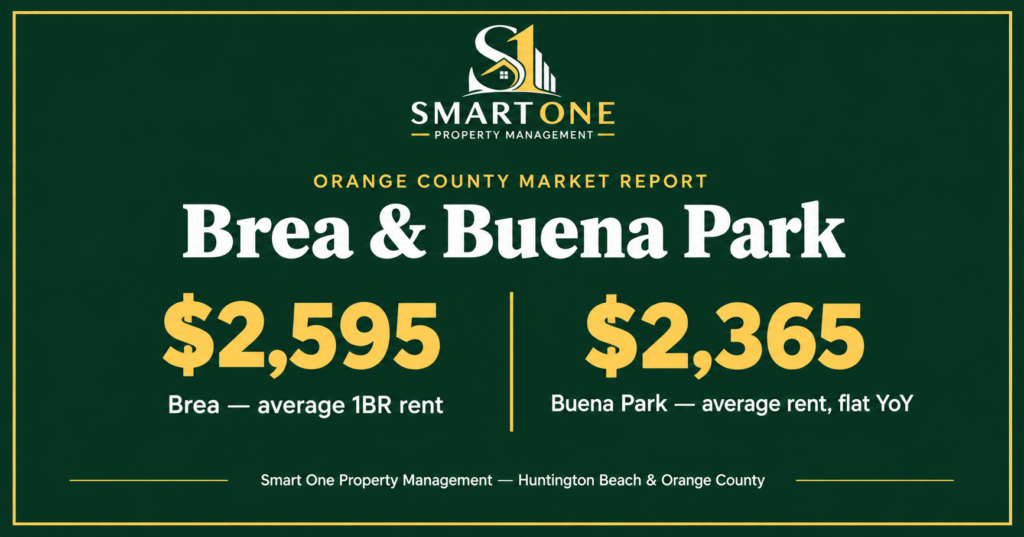
    Brea’s apartment rents run in the mid-$2,500s — RentCafe and Zillow both put one-bedroom units around $2,595–$2,597, with two-bedrooms closer to $2,965. But the citywide median rent across all property types (including single-family homes) is reported closer to $3,200, a meaningful gap from the apartment-only figures. That spread suggests Brea’s rental market is a genuine mix — a solid apartment stock alongside a meaningful share of single-family rentals pulling the overall median higher.

    For owners, that mix matters: comparing your property to a single citywide “average” can be misleading in Brea specifically, since an apartment and a single-family rental are being pulled from very different parts of that average. Comparable-property pricing matters more here than in a more uniform apartment market.

    Buena Park: a steady, moderately priced market

    Buena Park’s average rent sits closer to $2,333–$2,397, with the largest share of rentals — about 46% — falling in the $2,001–$2,500 range. Rent growth has been modest, around 0.35% year-over-year, essentially flat. Renter-occupied households make up about 44% of the city, a fairly even split with owner-occupied homes, which points to a stable, established rental base rather than a market in rapid transition.

    For owners, Buena Park looks like a consistency play — rents aren’t spiking, but they’re not softening either, and a well-priced, well-maintained unit in the dominant $2,001–$2,500 band should find qualified tenants without much friction.

    A vacancy data gap worth noting

    Neither city had reliable, city-specific vacancy rate data available in this search — a reminder that granular local data isn’t always published at the city level the way rent data is. As a reference point, Orange County’s broader multifamily vacancy rate has been running in the 4.0–4.3% range in 2026, per Kidder Mathews’ regional data cited in our earlier vacancy report. Absent city-specific numbers, that countywide figure is the best available baseline, though it should be treated as directional rather than precise for either Brea or Buena Park specifically.

    What this means if you own in either market

    In Brea, know which comparables you’re actually being measured against — apartment or single-family — before trusting a single average. In Buena Park, the story is less about volatility and more about disciplined pricing within a well-established, moderately priced band. Both are reminders that a citywide number is a starting point, not a pricing strategy — a principle that applies to every city in this series.

    Own a rental in Brea, Buena Park, or elsewhere in Orange County and want to know how your property compares to current market data? Reach out to Smart One Property Management.
    Sources: RentCafe, Average Rent in Brea, CA; Zillow Rental Manager, Average Rental Price in Brea, CA; RentCafe, Average Rent in Buena Park, CA; Zillow Rental Manager, Average Rental Price in Buena Park, CA.

  • What Happens to a Rental Property When the Owner Passes in California?

    Losing a family member is hard enough without also having to figure out what happens to a rental property they owned. It’s not a topic anyone wants to think about in advance, but for property owners — and for the family members who may end up handling an estate — understanding how this works in California can prevent a difficult time from becoming even more complicated.

    Protecting what matters. What happens to your rental property and how to plan ahead.

    The lease generally survives

    If the property was rented to a tenant under a lease, that lease doesn’t end just because the owner passed away. Tenants keep the same protections and obligations they had before, and whoever takes over the property — an executor, a trustee, or an heir — is legally required to honor the existing lease terms until it naturally expires or the tenant moves out under normal circumstances. A tenant generally has nothing to worry about simply because the person who owned the property has died.

    Who takes over depends on how the property was held

    This is where the details matter most, and where the difference between a will and a living trust becomes very real.

    If the property goes through probate, the estate’s executor becomes responsible for managing it during the probate process — collecting rent, handling necessary repairs, and making decisions about the lease — until the court formally transfers ownership to an heir or the property is sold. Probate in California can take months, sometimes longer, during which the property still needs active, responsible management.

    If the property was held in a living trust, probate is typically avoided altogether. A successor trustee steps in and can usually begin managing the property, collecting rent, and eventually distributing or selling it much faster than the probate process allows. This is one of the main reasons estate planning attorneys often recommend placing rental property in a trust rather than relying on a will alone.

    What tends to go wrong during this transition

    Even with clear legal rules, the period after an owner’s death is often when property management quietly falls apart. Family members juggling grief, probate paperwork, and unfamiliar landlord responsibilities can miss rent payments coming in, delay necessary repairs, or lose track of lease terms and renewal dates — not out of negligence, but because it’s simply not something they’ve had to manage before, at the worst possible time to be learning.

    The role of a property manager during this time

    This is exactly the kind of situation professional property management exists for. A property manager can continue operating the property exactly as it was — collecting rent, coordinating maintenance, communicating with tenants — while an executor or trustee handles the legal and financial side of the estate, without the family needing to become landlords overnight during an already difficult time. It also gives heirs breathing room to decide whether to keep, sell, or transfer the property without the pressure of also running it day to day.

    Planning ahead

    If you own rental property, the clearest way to protect your tenants, your heirs, and your property’s value is to talk with an estate planning attorney about how the property is titled — a living trust is often far simpler for heirs to manage than probate. This post is general information, not legal advice; every estate is different, and an attorney can walk through what makes sense for your specific situation. The California Courts Probate Self-Help Center is a good starting point for understanding the probate process itself.

    If your family is navigating this right now, or you want to plan ahead so your loved ones don’t have to figure it out alone, we’re here to help. Reach out to Smart One Property Management.