Author: smartonepropertymanagement

  • Cap Rate vs. Cash-on-Cash Return: Which Number Should Guide Your Next Purchase?

    Two investors can look at the exact same rental property and calculate two completely different “returns” — and both of them can be right. Cap rate and cash-on-cash return aren’t competing numbers. They’re answering different questions, and knowing which one matters more for a given decision is what keeps investors from comparing properties on the wrong basis entirely.

    What cap rate actually measures

    Cap rate (capitalization rate) is calculated as: Net Operating Income ÷ Purchase Price (or current market value). It tells you the return a property generates on its own, independent of how it’s financed. Two buyers — one paying all cash, one putting 20% down with a mortgage — get the exact same cap rate on the same property, because cap rate deliberately ignores financing altogether.

    That makes cap rate useful for comparing properties or markets on equal footing. A 6% cap rate property and a 4% cap rate property are being compared on the underlying asset’s performance, not on who financed it more aggressively.

    What cash-on-cash return actually measures

    Cash-on-cash return is calculated as: Annual Pre-Tax Cash Flow ÷ Total Cash Invested. Unlike cap rate, this number is entirely about your actual financing. It answers a more personal question: given the cash I actually put in — down payment, closing costs, initial repairs — what am I getting back each year?

    This is why cash-on-cash return can vary wildly between two buyers of the same property. More leverage (a smaller down payment) usually means a smaller cash investment, which can push cash-on-cash return higher — but it also means more debt service and more risk if cash flow tightens.

    An illustrative comparison

    Say a property generates $30,000 in annual NOI and sells for $500,000. Cap rate is $30,000 ÷ $500,000 = 6%. Now say a buyer puts 25% down ($125,000) plus $10,000 in closing costs and repairs, for $135,000 total cash invested, and after mortgage payments has $12,000 in annual pre-tax cash flow. Cash-on-cash return is $12,000 ÷ $135,000 = about 8.9%. Same property, two different numbers, both accurate — they just measure different things. (These figures are illustrative — run your own numbers based on actual financing terms and NOI for any real property.)

    Which one should guide your decision

    Neither number is “better” — the right one depends on what you’re trying to answer. Use cap rate when comparing properties or markets independent of financing, screening a list of potential purchases quickly, or evaluating a property you might buy in cash. Use cash-on-cash return when evaluating your actual expected return given your specific financing plan, or comparing how different down payment or loan structures affect the same deal.

    This connects directly to understanding an investor’s goals before making a recommendation — a cash-flow-focused investor using significant leverage cares most about cash-on-cash return, while an investor comparing markets or planning an all-cash purchase should be looking primarily at cap rate. Using the wrong number for the decision at hand is an easy way to misjudge a deal.

    The takeaway

    Cap rate tells you how a property performs. Cash-on-cash return tells you how your money performs in that property, given how you financed it. A well-informed purchase decision usually looks at both, understanding what each one is — and isn’t — telling you.

    Working through the numbers on a potential purchase and want a second opinion? Reach out to Smart One.

  • Orange County Market Report: Aliso Viejo & Anaheim

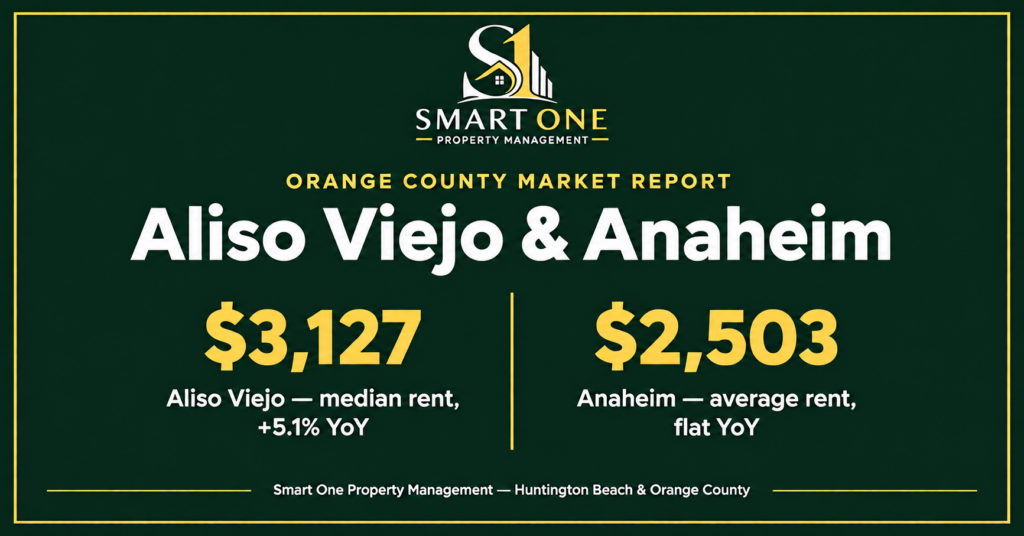
    This is the first in an ongoing series covering every city in Orange County — two cities at a time, so owners can see how their specific submarket compares to the county as a whole. We’re kicking it off with Aliso Viejo and Anaheim: two cities in very different parts of the rent spectrum, for very different reasons.

    Aliso Viejo: a smaller, higher-end market

    Aliso Viejo’s rents have kept climbing through the year. Apartment List’s September 2026 report puts the citywide median at $3,127 — up 5.1% year-over-year — with one-bedrooms averaging around $2,808 and two-bedrooms closer to $3,763. That’s up from the roughly $3,275 average RentCafe reported earlier this year, suggesting the market has continued tightening rather than leveling off. Citywide vacancy data specific to this month wasn’t available in this check, but the underlying dynamics — a smaller, planned community with limited new apartment supply — still hold and continue to support the tighter pricing.

    For owners, that combination — steady rent growth, low vacancy, limited new supply — has generally kept Aliso Viejo a landlord-favorable market, though it’s also a market where pricing precisely matters more: with fewer total rentals than a larger city, a unit priced even slightly off-market can sit noticeably longer relative to the size of the rental pool.

    Anaheim: a larger, more moderate market

    Anaheim tells a different story, and one that’s held steady through September: average rent remains close to $2,503 per month according to Zillow’s rental market data (RentCafe puts it slightly lower, around $2,466), with the largest share of listings — still about 39% — falling between $2,001 and $2,500. Rent growth has stayed essentially flat year-over-year. According to RealPage’s 2026 analytics, Anaheim’s metro apartment market has historically run one of the lowest vacancy rates in the country, though occupancy softened somewhat through late 2025 before recovering roughly 30 basis points between April and June 2026. New supply is a factor to watch here too — the Anaheim metro is expected to add around 4,800 new apartment units in 2026, which tends to put some downward pressure on rent growth and give renters more options.

    For owners, Anaheim represents a larger, more liquid rental market with more comparable properties to benchmark against — generally easier to price correctly, but also more exposed to the effect of new supply coming online nearby.

    What this means if you own in either market

    Aliso Viejo rewards precision — a smaller pool of comparable rentals means pricing needs to be dialed in, but low vacancy and limited new supply generally work in an owner’s favor. Anaheim rewards owners who are tracking new supply closely, since a wave of new units nearby can shift the local balance of negotiating power even while citywide averages look stable.

    Either way, the same principle from our national-vs-local vacancy post applies here too: county-wide or citywide averages are a starting point, not a pricing strategy. What matters is the trend in your specific neighborhood and property type.

    Own a rental in Aliso Viejo, Anaheim, or elsewhere in Orange County and want to know how your property compares to current market data? Reach out to Smart One Property Management.

    Sources: Apartment List, September 2026 Aliso Viejo Rent Report; RentCafe, Average Rent in Aliso Viejo, CA (2026); Zillow Rental Manager, Average Rental Price in Anaheim, CA; RealPage Analytics, Anaheim’s Apartment Market Stable in 2026.

  • Why Every Real Estate Investor’s Goal Is Different — And Why That Should Change Your Recommendation

    Not every investor wants the same thing — and treating them like they do is one of the most common mistakes an agent can make. Two clients can both call themselves “real estate investors” and want almost opposite properties, in opposite locations, at opposite price points. The agent who understands real estate investor goals before making a recommendation serves the client well. The agent who doesn’t ends up showing the wrong properties, losing trust, or — worse — putting a client into a deal that doesn’t actually fit what they were trying to accomplish.

    The goals aren’t all the same

    Cash flow. Some investors want monthly income, full stop. They’re less concerned with a property’s long-term appreciation potential and more focused on rent-to-price ratio, vacancy risk, and ongoing operating costs. A high-appreciation neighborhood with thin cash flow margins is often the wrong fit here, even if it looks like a “good” investment on paper.

    Appreciation. Other investors are playing a longer game — they’re comfortable with lower or even negative cash flow in exchange for equity growth over time. These clients are often more focused on location fundamentals, growth trends, and future development than on this month’s rent roll.

    Tax strategy. Some investors are moving equity out of one property and into another specifically to defer capital gains through a 1031 exchange, or structuring a purchase around depreciation and other tax benefits. These transactions come with strict timelines and requirements — the IRS’s guidance on like-kind exchanges is worth understanding well enough to at least recognize when a client should be talking to their CPA before, not after, they make an offer.

    Portfolio diversification. Some clients aren’t looking for their best possible deal — they’re looking for a specific piece to round out a portfolio: a different property type, a different market, or a different level of risk than what they already own.

    Value-add or short-term. Flippers and short-term investors need a completely different lens — after-repair value, renovation cost estimates, and holding costs during the project, rather than long-term rent projections at all.

    Legacy and generational wealth. Some investors aren’t optimizing for return at all in the traditional sense. They’re building something to pass down, and stability, location, and long-term hold potential matter more than maximizing yield.

    Why this matters more than it seems

    Recommending a property without understanding which of these goals a client is actually working toward isn’t just inefficient — it can actively work against them. A cash-flow investor steered toward an appreciation play may end up subsidizing a property every month and resenting the advice that put them there. A legacy-focused client pushed toward an aggressive value-add project may take on more risk and hands-on work than they ever wanted. Good intentions don’t prevent a mismatched recommendation from damaging trust, and trust is the entire foundation of a long-term client relationship.

    Questions worth asking before the first showing

    Before pulling listings, it’s worth understanding: Is this investor looking for income now, growth later, or both? What’s their tolerance for hands-on work — value-add and renovation, or a truly passive hold? Is there a tax or timeline consideration driving the purchase, like a 1031 exchange deadline? Is this a standalone investment decision, or part of a broader portfolio strategy? And just as important — is this a first investment property, or does the client already have experience to draw on?

    The answers change which properties are worth showing at all, not just how they’re presented once you’re there.

    The takeaway

    Every investor is optimizing for something — but it’s rarely the same thing twice. Taking the time to understand a client’s actual goal before making a recommendation isn’t extra work on top of the job. It is the job. It’s the difference between an agent who sells a property and an agent who serves a client.

    Working with investors and want a team that takes the time to understand what you’re actually trying to build? Reach out to Smart One.

  • Are You Making These Common Lease Violation Mistakes?

    A lease violation — unauthorized pets, an extra occupant who isn’t on the lease, late rent that’s becoming a pattern — is stressful enough on its own. What actually gets owners into trouble, though, is often how the violation gets handled rather than the violation itself. Here are the lease violation mistakes landlords make most often, and what to do instead.

    Handling a Lease Violation the Right Way

    Handling it verbally instead of in writing

    A phone call or a conversation at the door might feel like the easier first step, but if the issue continues, you’ll wish you had it in writing. Every lease violation notice should be documented — what the violation is, when it occurred, and what needs to happen to resolve it — even if you also address it in person first. Verbal warnings are nearly impossible to enforce later if the situation escalates.

    Inconsistent enforcement

    Letting one tenant slide on a late fee while enforcing it strictly for another isn’t just unfair — it can undermine your position if a dispute ever ends up in front of a judge, and it can raise fair housing concerns if the inconsistency lines up with a protected characteristic, even unintentionally. Whatever your policy is, it needs to apply the same way to everyone.

    Skipping the required notice period

    California law requires specific types of notice — and specific time periods — depending on the violation. Jumping straight to an eviction filing without providing the legally required notice and opportunity to cure is one of the fastest ways to have a case dismissed, which costs you time, filing fees, and often another full notice cycle before you can try again. The California Courts Self-Help Center’s guide to evictions is a useful starting point for understanding notice requirements before taking action.

    Escalating too fast

    Not every violation needs to end in an eviction notice. A first-time, minor violation — a guest staying slightly longer than the lease allows, for example — is often better handled with a documented conversation and a clear expectation going forward. Save formal notices and legal escalation for violations that are serious, repeated, or left unresolved after a good-faith attempt to fix them.

    Not knowing when a violation is actually a lease issue at all

    Sometimes what looks like a violation is actually a maintenance issue in disguise — a tenant who stopped paying rent because a habitability issue went unaddressed, for example. Handling it purely as a lease violation without looking at the full picture can create bigger legal exposure than the original issue.

    Why this trips up self-managing owners specifically

    Every one of these mistakes tends to come from the same root cause: handling an infrequent, high-stakes situation without a repeatable process already in place. A property manager who deals with lease violations regularly knows the correct notice type, the required timeline, and when a situation calls for a conversation versus a formal notice — because it’s not a once-a-year decision for them, it’s a process they run consistently. If you’ve found tenant issues to be the hardest part of self-managing, that’s often one of the clearest signs it’s time to hire a property manager, and it connects directly to the kind of tenant screening that helps prevent these situations from coming up in the first place.

    How Smart One handles lease violations

    At Smart One, every lease violation is documented, addressed with the legally required notice, and handled consistently across every property we manage — protecting owners from the compliance risk that comes with getting it wrong.

    Dealing with a tenant issue you’re not sure how to handle? Contact Smart One Property Management today.

  • AppFolio Owner Portal: What It Means for You as a Smart One Client

    Smart One Property Management has moved to AppFolio, one of the property management industry’s leading software platforms, to power how we manage your property and how you stay informed about it. If you’re a current client, here’s what that means for you day to day. If you’re considering Smart One, here’s what to expect once you’re onboard.

    Real-time financial visibility

    The AppFolio owner portal gives you on-demand access to your property’s financial activity — rent collected, expenses, and disbursements — without waiting on a monthly email or a phone call to get an answer. Statements are available online whenever you want to check them, and historical records stay accessible so you can review past months without digging through old paperwork.

    Maintenance updates you can actually see

    When a maintenance request comes in on your property, you can track its status through the portal — from the initial request through vendor scheduling and completion — instead of relying on a recap after the fact. That transparency is part of what dedicated maintenance coordination should include: not just handling the repair, but keeping you informed while it happens.

    Documents and statements in one place

    Leases, inspection reports, and other property documents are stored in the portal, so you’re not searching through email threads to find something you need. Everything tied to your property lives in one account you can access anytime.

    Why we made the switch

    We moved to AppFolio because it gives our clients a more transparent, real-time view into their property than our previous system did — and because it lets our team manage maintenance coordination, accounting, and communication more efficiently, which translates directly into faster response times for you. This wasn’t a change we made lightly; it’s an investment in the kind of visibility and responsiveness we think property management should include as a baseline, not an upgrade.

    Getting started

    If you’re a current Smart One client, you’ll receive an email invitation to set up your AppFolio owner portal login — reach out to our team if you haven’t received yours or need help getting set up. If you’re not yet a client and this kind of visibility is something you’ve been missing with your current management situation, this is exactly the kind of transparency we’ve built our process around.

    Questions about the new portal, or curious what real-time visibility into your property could look like? Reach out to Smart One Property Management today.

  • Self-Managing vs. Hiring a Property Manager: A Cost-Benefit Breakdown

    The management fee is the easiest number to compare when you’re weighing self-managing vs. hiring a property manager — and it’s also the least useful one on its own. A monthly percentage is easy to see. What it’s replacing is harder to measure, which is exactly why so many owners underestimate what self-managing actually costs them.

    What hiring a property manager actually costs.

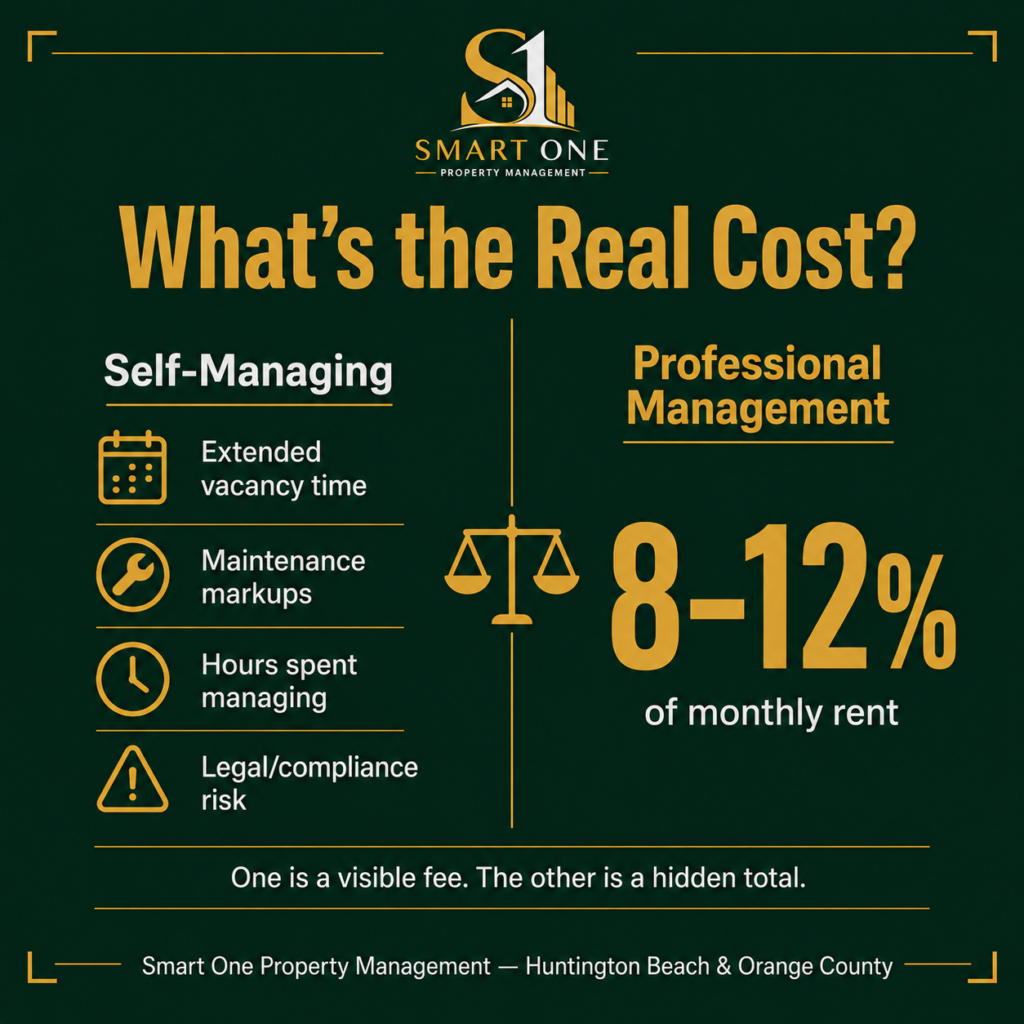
    Property management fees typically run 8–12% of monthly collected rent, with 10% the most common rate for single-family rentals, according to industry data compiled by All Property Management. Most companies also charge a one-time tenant placement fee, commonly 50–100% of the first month’s rent, when a new tenant is placed. That means first-year costs often run higher than the ongoing monthly rate before settling into a lower, more predictable cost in renewal years.

    That’s the visible cost. It buys marketing and showings, tenant screening, rent collection, maintenance coordination, and legal compliance handled by someone who does it full-time.

    What self-managing actually costs

    Self-managing doesn’t have a line-item fee, which is exactly why it’s easy to underestimate. The real costs show up as extended vacancy time when a listing isn’t priced or marketed as effectively, maintenance markups from paying retail rates without a vendor network, and the time cost of fielding calls, showings, and paperwork yourself — plus the legal exposure if a notice, screening decision, or habitability issue isn’t handled correctly. None of these show up on a single bill, but they add up over a full year in a way that’s easy to miss until you actually total it.

    A simple way to run your own numbers

    Start with your annual rent roll, then subtract what a property manager would charge (roughly 8–12%, reach out to Smart One today for our most competitive rate). That’s your “cost of hiring.” Then estimate what self-managing has actually cost you: any extra vacancy days beyond what a professionally marketed listing would see, any maintenance costs above what negotiated vendor rates would run, and a reasonable hourly value for the time you spend managing the property, multiplied by hours spent per month. Add those up, and compare the total to the management fee. For many self-managing owners, the gap is smaller than they expect — or the management fee turns out to be cheaper once time and mistakes are priced in honestly.

    When self-managing genuinely makes sense

    This isn’t a blanket case for hiring a property manager. Self-managing can make sense if you enjoy being hands-on, have the time and proximity to respond quickly, and are comfortable staying current on landlord-tenant law. It tends to make less sense as your portfolio grows, if you don’t live near the property, or if maintenance and tenant issues are the parts of ownership you dread most — that discomfort is usually a more honest signal than the management fee percentage alone.

    The real comparison

    The management fee isn’t the full cost of self-managing versus hiring help — it’s one side of a comparison that also includes vacancy, maintenance, time, and risk. Running the numbers honestly, rather than comparing “free” to a monthly percentage, is what actually tells you which option makes sense for your property.

    Want help running these numbers for your specific property? Contact Smart One Property Management today.

  • Buyers Are Sitting on the Sidelines. Here’s What That Means for Rental Owners.

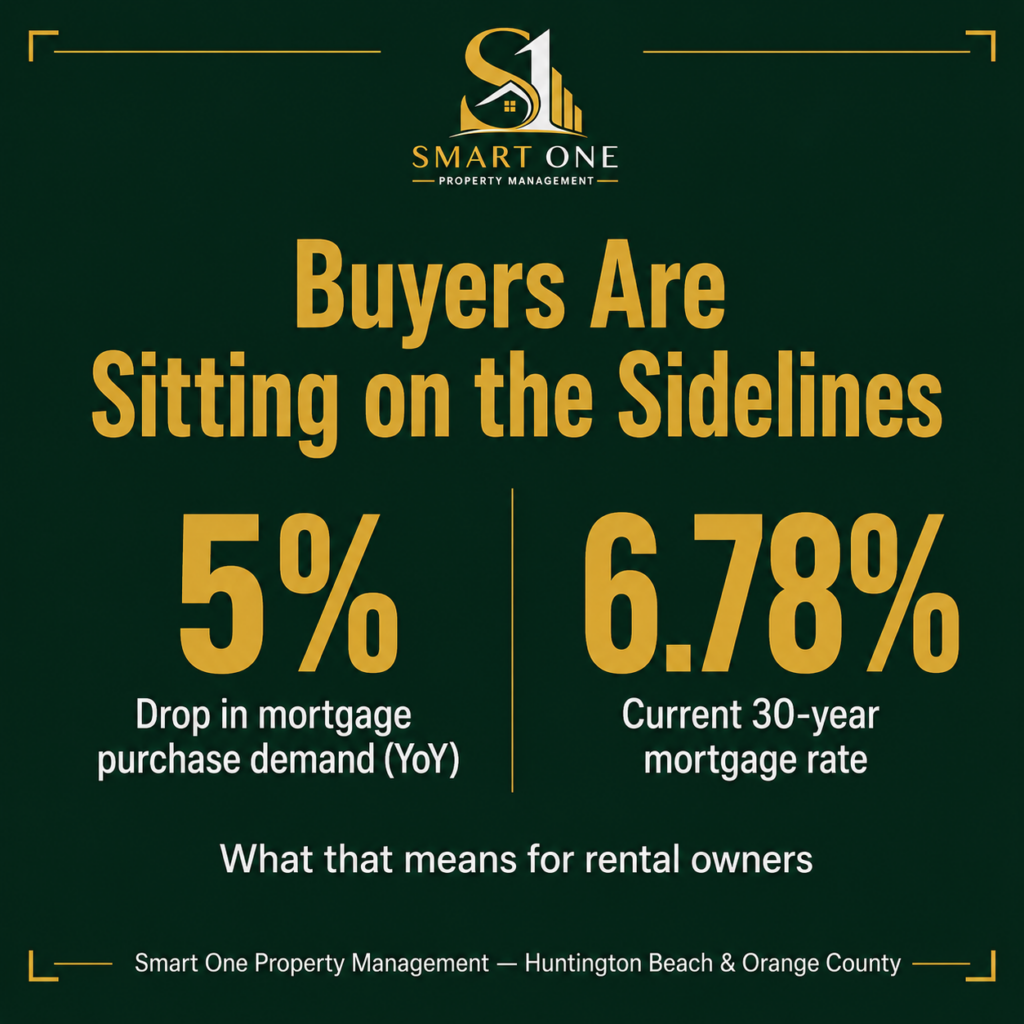
    Mortgage purchase applications are down 5% compared to this time last year, according to the Mortgage Bankers Association’s weekly survey for the period ending August 21, 2026. The 30-year fixed rate climbed to 6.78% — its highest level in three weeks — and refinance activity fell even further, down 17% year-over-year. On its own, that’s a data point about homebuyers. For rental property owners, it’s also a signal worth paying attention to.

    Why fewer buyers doesn’t mean less demand overall

    When mortgage rates rise, some people who would otherwise be buying a home stay renters instead — either because a monthly mortgage payment no longer pencils out compared to rent, or because they can’t qualify at current rates. That doesn’t shrink the total number of households needing housing. It shifts some of them from the buy side of the market to the rental side, which tends to support rental demand even while home sales activity cools.

    This is part of why rental vacancy in tighter markets like Orange County has stayed low even as national housing headlines have been mixed — the same rate environment that’s freezing out some buyers is keeping some renters renting longer than they might have otherwise planned to.

    What this means if you’re financing a purchase

    If you’re an investor considering financing an additional property right now, a 6.78% rate changes the math on returns compared to a lower-rate environment — higher monthly debt service eats into cash flow, which is exactly the kind of detail that should factor into understanding your goals before making a purchase decision. It doesn’t necessarily mean it’s the wrong time to buy; it means the numbers need to work at today’s rates, not last year’s.

    What this means if you already own

    For owners who financed at a lower rate, this environment is a reminder that your existing mortgage is a genuine asset — refinancing into today’s rates would likely raise your payment, not lower it, so unless there’s a specific reason to refinance (pulling equity, changing loan terms), there’s little incentive to touch it right now. For owners deciding whether to sell or hold, softer purchase demand can mean a longer time-to-sale if you’re weighing a sale, which is worth factoring in alongside the current rental vacancy picture in your specific market.

    The bigger picture

    Rate-driven shifts like this tend to move slowly and unevenly — national purchase demand data doesn’t translate one-to-one into what’s happening in any single Orange County submarket. But the general pattern is worth tracking: as long as borrowing stays expensive relative to rent, rental demand has a tailwind that owners can benefit from, provided pricing and property condition are keeping pace with what renters in the current market actually expect.

    Want help thinking through what today’s rate environment means for your specific property or portfolio? Reach out to Smart One Property Management.

    Source: Mortgage Bankers Association, Mortgage Applications Decrease in Latest MBA Weekly Survey, week ending August 21, 2026.

  • Maintenance Coordination: Why DIY Landlords Get Burned

    A maintenance request seems simple enough: something breaks, you find someone to fix it, the tenant’s happy, you move on. In practice, that’s where a lot of self-managing owners get burned. DIY maintenance coordination mistakes rarely show up as one big disaster — they show up as a slow drip of overpaid invoices, frustrated tenants, and the occasional legal exposure nobody saw coming.

    No vendor relationships means no leverage

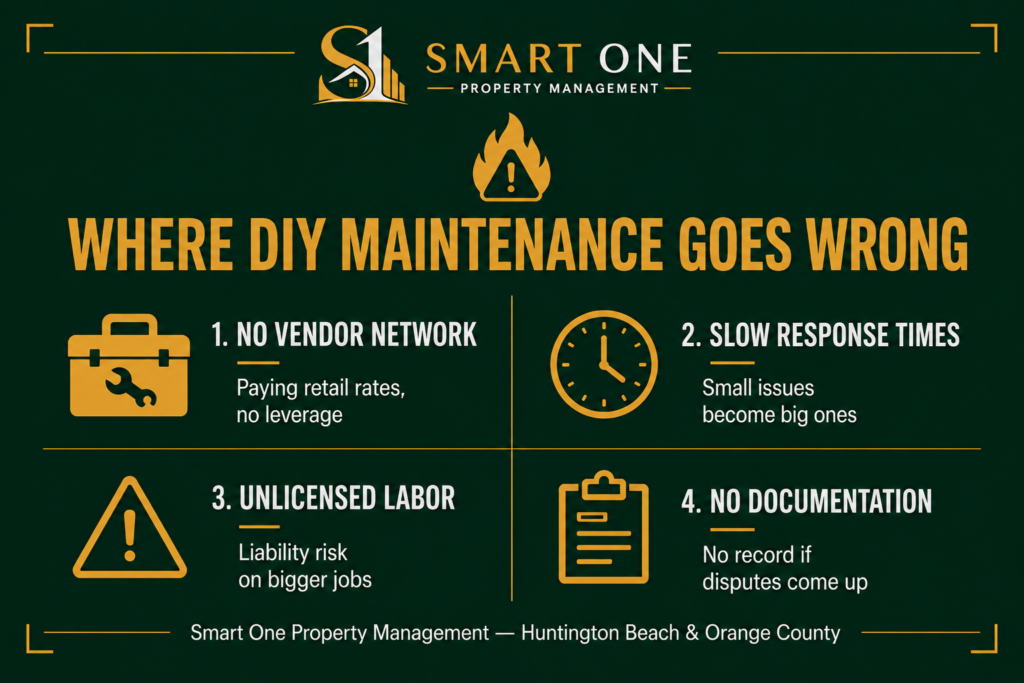
    Without an established network, most self-managing owners are calling around for whoever’s available — and paying whatever that vendor asks. There’s no negotiated rate, no volume pricing, and no easy way to know if a quote is fair without getting a second one, which takes even more time. Emergency repairs make this worse: a vendor who knows you need someone tonight has little incentive to give you their best price.

    Slow response times turn small problems into big ones

    A minor leak reported on a Friday and not addressed until Monday can turn into water damage, mold, or a habitability complaint by the time anyone gets to it. California law requires landlords to maintain rental units in habitable condition, and delays in addressing things like heating, plumbing, or safety issues can create real legal exposure — not just an unhappy tenant. Dedicated maintenance coordination exists specifically to close that gap between “reported” and “resolved.”

    Hiring the wrong person for the job

    Not every repair is a handyman job. In California, most work over $500 in combined labor and materials legally requires a licensed contractor, and using an unlicensed person for larger jobs — even someone reliable and cheap — can create liability if something goes wrong later. The California Contractors State License Board has guidance on when a license is actually required, and it’s worth knowing before hiring anyone for anything beyond a basic fix.

    Poor documentation

    When maintenance requests, vendor communications, and repair timelines only exist in text messages and memory, there’s no clear record if a tenant later disputes what was fixed, when, or how well. That gap becomes a real problem if a security deposit dispute or habitability claim ever escalates.

    Why this is where self-managing owners feel it most

    Maintenance is the part of self-managing that tends to wear owners down fastest, because it’s unpredictable — you can’t schedule around a burst pipe. It’s also where the hidden costs of self-managing show up most directly, in markups, delays, and the coordination time nobody accounts for. If maintenance requests are the part of the job you dread most, that’s often one of the clearer signs it’s time to hire a property manager.

    How Smart One handles maintenance differently

    At Smart One, every maintenance request runs through an established, vetted vendor network with negotiated rates — not whoever happens to be available. Requests are tracked and documented from report to resolution, and repairs requiring a licensed contractor are handled by one, every time. Owners get a fixed, predictable process instead of a new gamble every time something breaks.

    Tired of being the one fielding every maintenance call? Contact Smart One Property Management today.

  • FSBO Is Nearly Extinct. Here’s What Sellers Are Really Paying For.

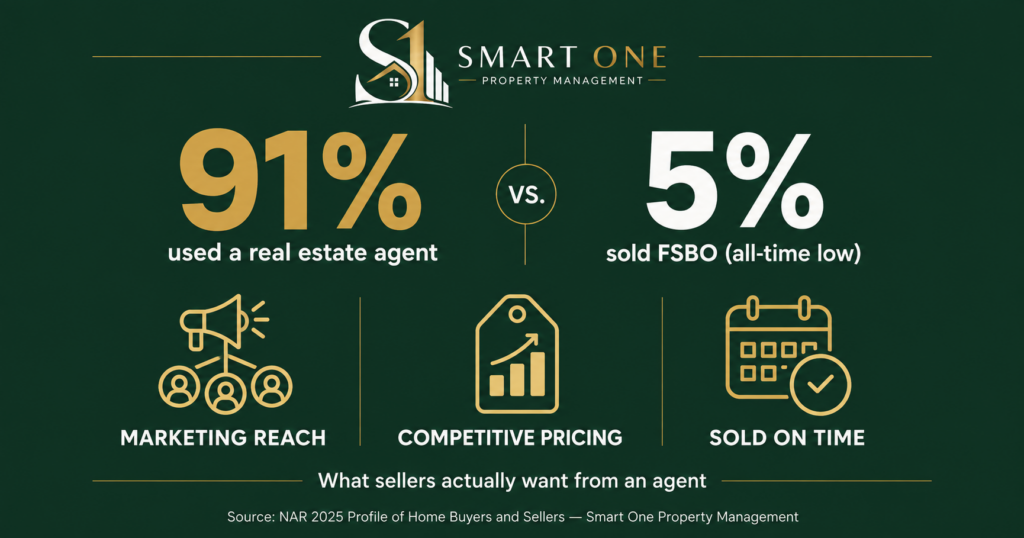
    Agent use among home sellers hit 91% in 2025, matching the highest share ever recorded, according to the National Association of Realtors’ Profile of Home Buyers and Sellers. For Sale By Owner transactions fell to just 5% — an all-time low. On their own, those numbers make a good headline. What’s more useful is what sellers want from a real estate agent in the first place — because that’s what’s actually driving the shift away from FSBO.

    The record numbers, briefly

    Agent-assisted sales have been climbing for years, and 2025 pushed that trend further: 91% of sellers used an agent, up from 90% the year before, while FSBO sales dropped to 5% of the market — the lowest share NAR has ever recorded. Sellers aren’t just defaulting to an agent out of habit. They’re actively choosing professional representation over doing it themselves, and the reasons behind that choice say more than the percentage does.

    What sellers want from a real estate agent

    According to NAR’s 2025 data, sellers’ top priorities in choosing an agent were help marketing the home to potential buyers, help pricing it competitively, and help selling within a specific timeframe. It’s not one thing — it’s the combination. Marketing reach without pricing strategy leads to a home that gets seen but doesn’t sell. Competitive pricing without a real marketing push leaves a well-priced home invisible to the buyers who’d actually want it. Sellers are looking for someone who handles both, along with everything in between.

    That combination shows up in another figure from the same report: 86% of sellers said their agent provided a broad range of services and managed most aspects of the sale — not just the listing, but negotiation, paperwork, inspections, and the dozens of smaller decisions that come up between “for sale” and “sold.”

    Why the 5% still go FSBO

    FSBO sellers aren’t choosing to skip an agent for the same reasons across the board. Roughly 30% of FSBO sales in NAR’s data went to a friend, relative, or neighbor — a transaction where a seller may reasonably feel a full agent-led marketing process isn’t necessary. Others cite avoiding commission costs as the primary driver. It’s worth noting NAR’s data also shows a real price gap between FSBO and agent-assisted sales — a median of $360,000 versus $425,000. That gap almost certainly reflects more than agent involvement alone (FSBO sales skew toward off-market, personal-network transactions that are structured differently from the start), but it’s a reasonable data point for a seller weighing the decision to consider alongside everything else.

    Is FSBO worth it? What to weigh before deciding

    The record-high agent usage number isn’t really the takeaway. The takeaway is what sellers are actually paying for when they choose an agent: broader buyer reach, a pricing strategy grounded in real data rather than a guess, and someone managing the transaction end-to-end so nothing falls through during negotiation, inspection, or closing. If you’re weighing FSBO against hiring an agent, that’s the real comparison to make — not “can I list my house myself,” but “can I replicate the marketing reach, pricing accuracy, and full-service management that’s driving 91% of sellers to choose an agent in the first place.”

    The same logic holds for rental property owners deciding whether to self-manage. The value of professional representation was never about the license — it’s about reach, accurate pricing, and someone managing the full process so nothing gets missed. That’s as true for a rental listing as it is for a home sale.

    Own a rental in Orange County and want that same level of marketing reach, accurate pricing, and full-service management working for you? Reach out to Smart One Property Management.

    Source: National Association of Realtors, 2025 Profile of Home Buyers and Sellers.

  • The National Rental Vacancy Rate Is 7.3%. Orange County’s Isn’t Even Close.

    Image of the pond at Fashion Island in Newport Beach, CA.

    Every quarter, the Census Bureau publishes a national rental vacancy rate, and every quarter it gets treated as a stand-in for “the rental market.” In the second quarter of 2026, that rate was 7.3% — roughly flat compared to a year earlier. If you own rental property in Huntington Beach or elsewhere in Orange County, that number tells you almost nothing about your actual market.

    Orange County is running well below the national rate

    Local data tells a very different story. Orange County’s multifamily vacancy rate was 4.3% in the second quarter of 2026, according to Kidder Mathews’ regional market research — up slightly from 3.8% a year earlier, but still well under national levels. Other local sources put the broader OC vacancy rate closer to 4.0–4.2%. Even with the recent uptick, Orange County remains one of the tighter, more landlord-favorable rental markets in Southern California.

    That gap matters. A landlord reading the national headline might expect softening demand, more negotiating leverage for tenants, or slower rent growth. An Orange County owner working from local numbers sees a market that, while normalizing off historically ultra-low vacancy, is still considerably tighter than most of the country.

    Why the national number and the local one diverge

    Rental vacancy isn’t uniform across the country, and it isn’t even uniform across California. Nationally, the Census Bureau reported rental vacancy at 9.5% in the South, 6.9% in the Midwest, 5.9% in the Northeast, and 5.3% in the West for the second quarter — with cities generally running higher than suburbs. Orange County’s multifamily rate sitting near 4.3% puts it below even the broader Western regional average, a reflection of constrained land supply, high barriers to new construction, and consistently strong demand.

    The slight year-over-year increase locally is worth watching, not ignoring. A move from roughly 3.8% to 4.3% is a real shift after years of vacancy sitting in the 2–3% range, and it’s consistent with new apartment supply working its way through parts of the county. But “up slightly from historically tight” and “loosening market” are two very different stories, and only one of them is accurate here.

    What this means for owners

    If you’re setting rent, evaluating a purchase, or deciding whether to hold or sell a rental property, the national vacancy rate is close to irrelevant. What matters is the vacancy rate in your specific submarket and property type, how it’s trended over the past year, and what’s in the pipeline nearby that could change it — new apartment communities, shifting renter demand, or seasonal patterns specific to the neighborhood.

    That’s the level of detail a property manager should be tracking on your behalf. Smart One Property Management monitors rental vacancy, rent trends, and new supply across Huntington Beach and Orange County so owners can price and manage their properties based on what’s actually happening locally — not a national statistic that doesn’t reflect this market.

    Want to know how your rental compares to current Orange County vacancy and rent trends? Reach out to Smart One Property Management.


    Sources: U.S. Census Bureau, Quarterly Residential Vacancies and Homeownership, Second Quarter 2026, released July 28, 2026; Kidder Mathews, Orange County Multifamily Market Report, Q2 2026.