
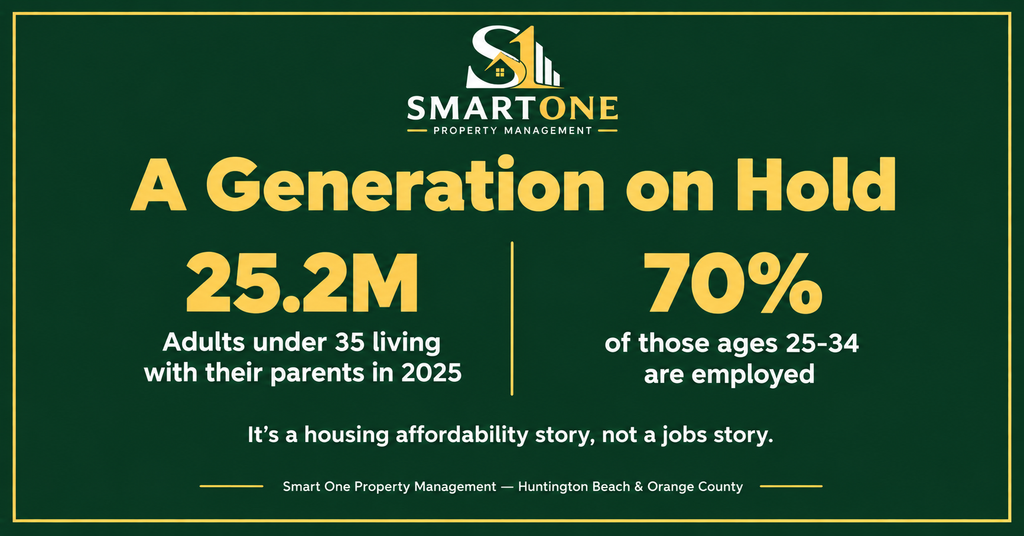
A record 25.2 million Americans under age 35 lived with their parents in 2025, according to a Realtor.com analysis of Census data — nearly one in three young adults, and more than during the height of the pandemic. It’s easy to read that as a story about young people, but it’s equally a story about housing: where those adults would otherwise be living, and what happens to demand when they finally move out.
It’s not a jobs problem
The assumption behind the headline is often that these adults can’t afford to leave because they aren’t working. The data says otherwise: about 70% of 25- to 34-year-olds living with their parents are employed. Among those ages 25 to 29, about 20.4% lived with a parent in 2025, and among 30- to 34-year-olds, 12.7% did — up from just 7.1% in 2000. Pew Research has found that most of these adults contribute financially to the household, with many helping cover groceries, utilities, or even rent or mortgage costs.
This is a housing affordability story. Realtor.com estimates the median home listing price hit $430,000 in 2025, up 34% from 2019, while median asking rent rose nearly 18% over the same stretch — and a roughly 4-million-unit housing supply gap leaves many young adults without realistic ways to form their own households.
What it means for the broader market
Every adult living at home is a household that hasn’t formed yet — one that isn’t buying, and isn’t renting, at least not yet. That has two effects worth understanding:
Suppressed demand today. Fewer new households means fewer first-time buyers entering the market and fewer renters taking apartments. It’s one reason we’ve seen buyers sidelined and purchase demand soften, as we covered in our recent post on mortgage rates and rental demand.
Pent-up demand tomorrow. These aren’t people who’ve opted out of housing — they’re delayed. When affordability improves, wages catch up, or rates ease, a large share of them are likely to move out at roughly the same time, which tends to land first on the rental market.
What this means for rental owners and property managers
For owners of entry-level rentals — studios, one-bedrooms, and smaller units in more accessible cities — a large pool of delayed would-be renters is a meaningful signal: demand is being held back by affordability, not by lack of interest. A few practical implications follow:
Expect more applicants with parental guarantors or co-signers. Young adults earlier in their careers, or those moving out for the first time, often rely on a parent’s financial backing to qualify. That’s a normal part of screening, and it’s worth having a consistent, documented process for evaluating guarantors — consistent with the tenant screening best practices we’ve covered.
Plan for roommate and shared-housing arrangements. When rents outpace entry-level incomes, shared leases become more common, which raises questions about lease structure, occupancy limits, and how responsibility is divided among tenants.
Think about retention. A tenant who finally got out of a parent’s house is often highly motivated to stay put, and renewal terms that reward long-term stays tend to pay off in lower turnover.
The takeaway
The record number of adults living with their parents is a symptom of a housing market that has priced out a generation at precisely the moment they’d normally be forming households. For property owners, it points to demand that’s real but delayed — and to the value of being ready, with solid screening, pricing, and lease structure, when that demand moves.
Own a rental and want to think through how shifting renter demographics affect your pricing and screening strategy? Reach out to Smart One Property Management.
Source: Realtor.com analysis of U.S. Census Bureau data, as reported by CBS News, Record Number of U.S. Adults Are Moving in With Their Parents as Costs Rise and Pew Research Center, Shares of Young Adults Living With Parents Vary Widely Across the U.S..