Category: Property Management

  • Pet Policies: How to Protect Your Property and Stay Compliant

    A pet policy sounds like a simple property decision — allow pets or don’t, charge a fee or don’t. In practice, it’s one of the areas where self-managing owners run into the most legal risk, mainly because of one distinction that gets confused constantly: the difference between a pet and an assistance animal.

    Pets vs. assistance animals: not the same thing, legally

    A pet is a pet. An assistance animal — which includes both service animals and emotional support animals (ESAs) — is legally treated as a reasonable accommodation under fair housing law, not a pet at all. That distinction has real consequences: landlords cannot charge pet rent, a pet deposit, or any additional fee for a legitimate assistance animal, cannot apply breed, size, or number restrictions to one, and cannot deny one under a blanket “no pets” policy. California provides especially strong protections here through the federal Fair Housing Act, the state’s Fair Employment and Housing Act, and Assembly Bill 468, which as of 2026 requires ESA letters to come from a licensed mental health professional following a genuine 30-day patient-provider relationship — a meaningful guardrail against the instant-ESA-letter sites that circulated in past years.

    Denying a legitimate assistance animal is only allowed in narrow circumstances — the specific animal poses a documented safety or health threat, the tenant won’t provide requested (limited) documentation, or the accommodation would fundamentally alter the housing. Outside those situations, a no-pets policy simply doesn’t apply.

    What you can actually control for true pets

    For pets that aren’t assistance animals, owners have real flexibility: reasonable breed or size restrictions, a pet interview or meet-and-greet before approval, a pet count limit, and a written pet addendum spelling out expectations — leash rules, cleanup responsibility, noise, and what happens if damage occurs.

    The deposit cap changes what you can charge

    This is where a lot of existing pet policies are now out of date. Under California’s AB 12, effective since mid-2024, most landlords can collect no more than one month’s rent as a total security deposit — and that cap includes everything, pet deposits included. You can’t charge a full month’s security deposit and then stack a separate pet deposit on top; a “small landlord” (someone who owns two or fewer rental properties totaling four or fewer units) can collect up to two months, but that’s the outer limit either way. Pet rent, a recurring monthly charge rather than a deposit, is a separate, still-available tool for true pets, since it isn’t a deposit and falls outside the AB 12 cap.

    Put it in writing

    Whatever your policy is, document it clearly in the lease and a pet addendum, and apply it the same way to every applicant. Inconsistent enforcement is exactly the kind of lease violation mistake that creates fair housing exposure even when unintentional.

    This post is for general informational purposes only and is not legal advice — assistance animal accommodations and deposit rules carry real compliance risk, so consult an attorney or your property manager before finalizing a pet policy or responding to an accommodation request.

    How Smart One handles this

    At Smart One, every pet policy and assistance animal request is handled through a consistent, documented process — protecting owners from fair housing exposure while still giving true pet policies real teeth.

    Want help reviewing or setting up a compliant pet policy for your property? Reach out to Smart One Property Management.


  • What Happens to a Rental Property When the Owner Passes in California?

    Losing a family member is hard enough without also having to figure out what happens to a rental property they owned. It’s not a topic anyone wants to think about in advance, but for property owners — and for the family members who may end up handling an estate — understanding how this works in California can prevent a difficult time from becoming even more complicated.

    Protecting what matters. What happens to your rental property and how to plan ahead.

    The lease generally survives

    If the property was rented to a tenant under a lease, that lease doesn’t end just because the owner passed away. Tenants keep the same protections and obligations they had before, and whoever takes over the property — an executor, a trustee, or an heir — is legally required to honor the existing lease terms until it naturally expires or the tenant moves out under normal circumstances. A tenant generally has nothing to worry about simply because the person who owned the property has died.

    Who takes over depends on how the property was held

    This is where the details matter most, and where the difference between a will and a living trust becomes very real.

    If the property goes through probate, the estate’s executor becomes responsible for managing it during the probate process — collecting rent, handling necessary repairs, and making decisions about the lease — until the court formally transfers ownership to an heir or the property is sold. Probate in California can take months, sometimes longer, during which the property still needs active, responsible management.

    If the property was held in a living trust, probate is typically avoided altogether. A successor trustee steps in and can usually begin managing the property, collecting rent, and eventually distributing or selling it much faster than the probate process allows. This is one of the main reasons estate planning attorneys often recommend placing rental property in a trust rather than relying on a will alone.

    What tends to go wrong during this transition

    Even with clear legal rules, the period after an owner’s death is often when property management quietly falls apart. Family members juggling grief, probate paperwork, and unfamiliar landlord responsibilities can miss rent payments coming in, delay necessary repairs, or lose track of lease terms and renewal dates — not out of negligence, but because it’s simply not something they’ve had to manage before, at the worst possible time to be learning.

    The role of a property manager during this time

    This is exactly the kind of situation professional property management exists for. A property manager can continue operating the property exactly as it was — collecting rent, coordinating maintenance, communicating with tenants — while an executor or trustee handles the legal and financial side of the estate, without the family needing to become landlords overnight during an already difficult time. It also gives heirs breathing room to decide whether to keep, sell, or transfer the property without the pressure of also running it day to day.

    Planning ahead

    If you own rental property, the clearest way to protect your tenants, your heirs, and your property’s value is to talk with an estate planning attorney about how the property is titled — a living trust is often far simpler for heirs to manage than probate. This post is general information, not legal advice; every estate is different, and an attorney can walk through what makes sense for your specific situation. The California Courts Probate Self-Help Center is a good starting point for understanding the probate process itself.

    If your family is navigating this right now, or you want to plan ahead so your loved ones don’t have to figure it out alone, we’re here to help. Reach out to Smart One Property Management.

  • Cap Rate vs. Cash-on-Cash Return: Which Number Should Guide Your Next Purchase?

    Two investors can look at the exact same rental property and calculate two completely different “returns” — and both of them can be right. Cap rate and cash-on-cash return aren’t competing numbers. They’re answering different questions, and knowing which one matters more for a given decision is what keeps investors from comparing properties on the wrong basis entirely.

    What cap rate actually measures

    Cap rate (capitalization rate) is calculated as: Net Operating Income ÷ Purchase Price (or current market value). It tells you the return a property generates on its own, independent of how it’s financed. Two buyers — one paying all cash, one putting 20% down with a mortgage — get the exact same cap rate on the same property, because cap rate deliberately ignores financing altogether.

    That makes cap rate useful for comparing properties or markets on equal footing. A 6% cap rate property and a 4% cap rate property are being compared on the underlying asset’s performance, not on who financed it more aggressively.

    What cash-on-cash return actually measures

    Cash-on-cash return is calculated as: Annual Pre-Tax Cash Flow ÷ Total Cash Invested. Unlike cap rate, this number is entirely about your actual financing. It answers a more personal question: given the cash I actually put in — down payment, closing costs, initial repairs — what am I getting back each year?

    This is why cash-on-cash return can vary wildly between two buyers of the same property. More leverage (a smaller down payment) usually means a smaller cash investment, which can push cash-on-cash return higher — but it also means more debt service and more risk if cash flow tightens.

    An illustrative comparison

    Say a property generates $30,000 in annual NOI and sells for $500,000. Cap rate is $30,000 ÷ $500,000 = 6%. Now say a buyer puts 25% down ($125,000) plus $10,000 in closing costs and repairs, for $135,000 total cash invested, and after mortgage payments has $12,000 in annual pre-tax cash flow. Cash-on-cash return is $12,000 ÷ $135,000 = about 8.9%. Same property, two different numbers, both accurate — they just measure different things. (These figures are illustrative — run your own numbers based on actual financing terms and NOI for any real property.)

    Which one should guide your decision

    Neither number is “better” — the right one depends on what you’re trying to answer. Use cap rate when comparing properties or markets independent of financing, screening a list of potential purchases quickly, or evaluating a property you might buy in cash. Use cash-on-cash return when evaluating your actual expected return given your specific financing plan, or comparing how different down payment or loan structures affect the same deal.

    This connects directly to understanding an investor’s goals before making a recommendation — a cash-flow-focused investor using significant leverage cares most about cash-on-cash return, while an investor comparing markets or planning an all-cash purchase should be looking primarily at cap rate. Using the wrong number for the decision at hand is an easy way to misjudge a deal.

    The takeaway

    Cap rate tells you how a property performs. Cash-on-cash return tells you how your money performs in that property, given how you financed it. A well-informed purchase decision usually looks at both, understanding what each one is — and isn’t — telling you.

    Working through the numbers on a potential purchase and want a second opinion? Reach out to Smart One.

  • Are You Making These Common Lease Violation Mistakes?

    A lease violation — unauthorized pets, an extra occupant who isn’t on the lease, late rent that’s becoming a pattern — is stressful enough on its own. What actually gets owners into trouble, though, is often how the violation gets handled rather than the violation itself. Here are the lease violation mistakes landlords make most often, and what to do instead.

    Handling a Lease Violation the Right Way

    Handling it verbally instead of in writing

    A phone call or a conversation at the door might feel like the easier first step, but if the issue continues, you’ll wish you had it in writing. Every lease violation notice should be documented — what the violation is, when it occurred, and what needs to happen to resolve it — even if you also address it in person first. Verbal warnings are nearly impossible to enforce later if the situation escalates.

    Inconsistent enforcement

    Letting one tenant slide on a late fee while enforcing it strictly for another isn’t just unfair — it can undermine your position if a dispute ever ends up in front of a judge, and it can raise fair housing concerns if the inconsistency lines up with a protected characteristic, even unintentionally. Whatever your policy is, it needs to apply the same way to everyone.

    Skipping the required notice period

    California law requires specific types of notice — and specific time periods — depending on the violation. Jumping straight to an eviction filing without providing the legally required notice and opportunity to cure is one of the fastest ways to have a case dismissed, which costs you time, filing fees, and often another full notice cycle before you can try again. The California Courts Self-Help Center’s guide to evictions is a useful starting point for understanding notice requirements before taking action.

    Escalating too fast

    Not every violation needs to end in an eviction notice. A first-time, minor violation — a guest staying slightly longer than the lease allows, for example — is often better handled with a documented conversation and a clear expectation going forward. Save formal notices and legal escalation for violations that are serious, repeated, or left unresolved after a good-faith attempt to fix them.

    Not knowing when a violation is actually a lease issue at all

    Sometimes what looks like a violation is actually a maintenance issue in disguise — a tenant who stopped paying rent because a habitability issue went unaddressed, for example. Handling it purely as a lease violation without looking at the full picture can create bigger legal exposure than the original issue.

    Why this trips up self-managing owners specifically

    Every one of these mistakes tends to come from the same root cause: handling an infrequent, high-stakes situation without a repeatable process already in place. A property manager who deals with lease violations regularly knows the correct notice type, the required timeline, and when a situation calls for a conversation versus a formal notice — because it’s not a once-a-year decision for them, it’s a process they run consistently. If you’ve found tenant issues to be the hardest part of self-managing, that’s often one of the clearest signs it’s time to hire a property manager, and it connects directly to the kind of tenant screening that helps prevent these situations from coming up in the first place.

    How Smart One handles lease violations

    At Smart One, every lease violation is documented, addressed with the legally required notice, and handled consistently across every property we manage — protecting owners from the compliance risk that comes with getting it wrong.

    Dealing with a tenant issue you’re not sure how to handle? Contact Smart One Property Management today.

  • Self-Managing vs. Hiring a Property Manager: A Cost-Benefit Breakdown

    The management fee is the easiest number to compare when you’re weighing self-managing vs. hiring a property manager — and it’s also the least useful one on its own. A monthly percentage is easy to see. What it’s replacing is harder to measure, which is exactly why so many owners underestimate what self-managing actually costs them.

    What hiring a property manager actually costs.

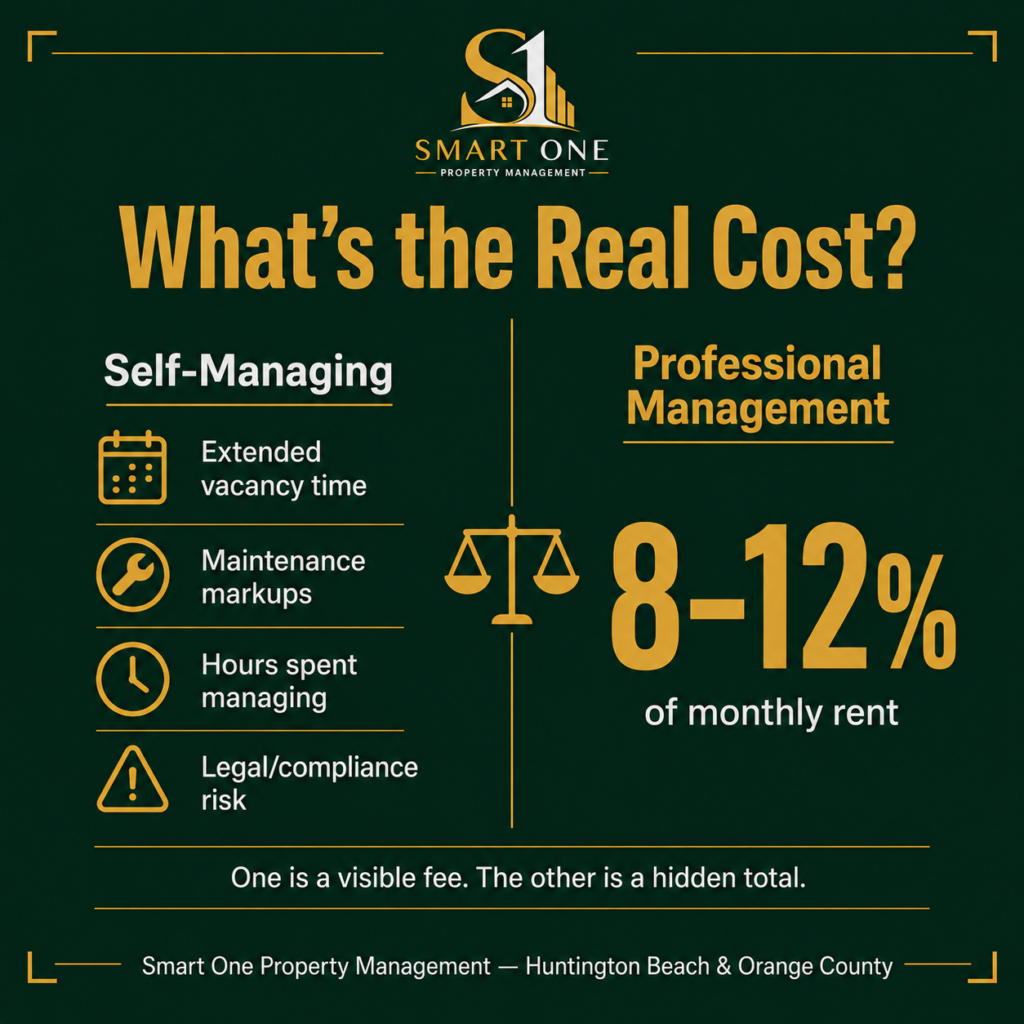
    Property management fees typically run 8–12% of monthly collected rent, with 10% the most common rate for single-family rentals, according to industry data compiled by All Property Management. Most companies also charge a one-time tenant placement fee, commonly 50–100% of the first month’s rent, when a new tenant is placed. That means first-year costs often run higher than the ongoing monthly rate before settling into a lower, more predictable cost in renewal years.

    That’s the visible cost. It buys marketing and showings, tenant screening, rent collection, maintenance coordination, and legal compliance handled by someone who does it full-time.

    What self-managing actually costs

    Self-managing doesn’t have a line-item fee, which is exactly why it’s easy to underestimate. The real costs show up as extended vacancy time when a listing isn’t priced or marketed as effectively, maintenance markups from paying retail rates without a vendor network, and the time cost of fielding calls, showings, and paperwork yourself — plus the legal exposure if a notice, screening decision, or habitability issue isn’t handled correctly. None of these show up on a single bill, but they add up over a full year in a way that’s easy to miss until you actually total it.

    A simple way to run your own numbers

    Start with your annual rent roll, then subtract what a property manager would charge (roughly 8–12%, reach out to Smart One today for our most competitive rate). That’s your “cost of hiring.” Then estimate what self-managing has actually cost you: any extra vacancy days beyond what a professionally marketed listing would see, any maintenance costs above what negotiated vendor rates would run, and a reasonable hourly value for the time you spend managing the property, multiplied by hours spent per month. Add those up, and compare the total to the management fee. For many self-managing owners, the gap is smaller than they expect — or the management fee turns out to be cheaper once time and mistakes are priced in honestly.

    When self-managing genuinely makes sense

    This isn’t a blanket case for hiring a property manager. Self-managing can make sense if you enjoy being hands-on, have the time and proximity to respond quickly, and are comfortable staying current on landlord-tenant law. It tends to make less sense as your portfolio grows, if you don’t live near the property, or if maintenance and tenant issues are the parts of ownership you dread most — that discomfort is usually a more honest signal than the management fee percentage alone.

    The real comparison

    The management fee isn’t the full cost of self-managing versus hiring help — it’s one side of a comparison that also includes vacancy, maintenance, time, and risk. Running the numbers honestly, rather than comparing “free” to a monthly percentage, is what actually tells you which option makes sense for your property.

    Want help running these numbers for your specific property? Contact Smart One Property Management today.

  • Tenant Screening 101: What Orange County Landlords Need to Know

    A bad tenant placement is one of the most expensive mistakes a rental property owner can make — unpaid rent, property damage, and in the worst cases, a months-long eviction process. Good tenant screening for Orange County landlords isn’t about being suspicious of every applicant. It’s about having a consistent process that catches real red flags while staying compliant with California’s landlord-tenant and fair housing laws.

    Here’s what that process should actually include.

    Start with a written screening criteria

    Before you look at a single application, decide — in writing — what you’re screening for: minimum credit score, income-to-rent ratio, rental history requirements, and so on. Applying the same criteria to every applicant isn’t just good practice, it’s your best protection against a fair housing complaint. Screening decisions that vary from applicant to applicant, even unintentionally, are where landlords run into legal trouble.

    What to actually check

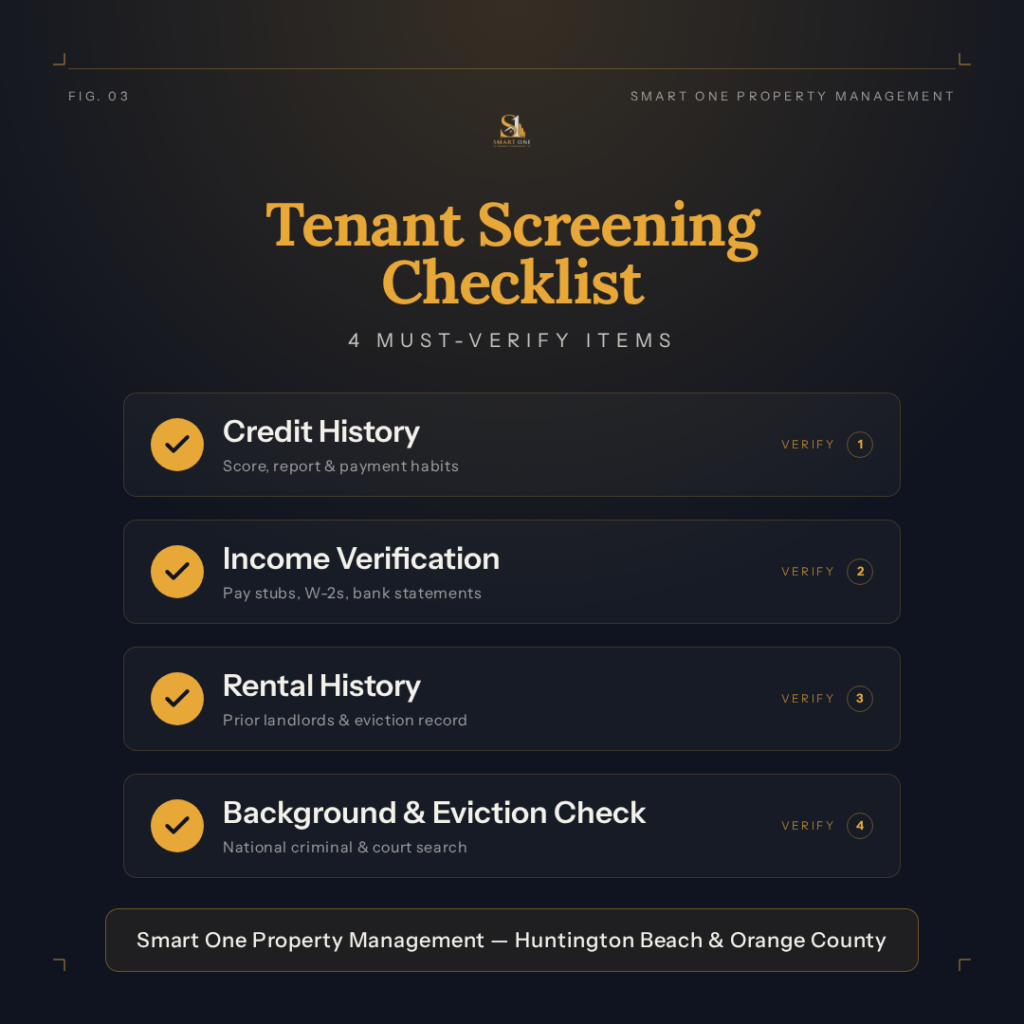
    Credit history. Look for payment patterns, not just a single score. A 650 with a clean payment history can be a safer bet than a 700 with recent missed payments.

    Income verification. A common standard is gross monthly income at least 2.5–3x the rent, verified with recent pay stubs, an offer letter, or bank statements for self-employed applicants — not just a stated number on the application.

    Rental history. Call previous landlords directly rather than relying on references the applicant provides. Ask about on-time payment, property condition at move-out, and whether they’d rent to this tenant again.

    Eviction and criminal history. Run these through a proper tenant screening service, not a general internet search. California and many Orange County cities have specific rules about how criminal history can factor into a housing decision, so this step needs to be handled carefully and consistently.

    Red flags most owners miss

    A rushed explanation for a credit or rental history gap is worth a second look, not an automatic pass. Pay stubs or bank statements that look edited or inconsistent are a serious flag. So is an applicant who pushes hard to skip a step in your process — asking to move in before screening finishes, or offering extra deposit money to speed things along. None of these automatically disqualify someone, but they’re reasons to slow down and verify rather than take the application at face value.

    Where California law adds risk

    Application screening fees, adverse action notice requirements, and security deposit handling are all governed by specific California statutes — Civil Code Section 1950.6 covers what you can charge for screening and what you’re required to disclose to a rejected applicant. Getting this wrong, even by accident, can expose you to real liability regardless of whether the underlying screening decision was reasonable.

    If tenant screening is the part of self-managing that makes you the most nervous, that’s often one of the clearest signs it’s time to hire a property manager — along with the hidden costs of self-managing that tend to show up when a screening decision goes wrong.

    How Smart One screens every applicant

    At Smart One, every applicant goes through the same documented process — credit, income verification, rental history checks with previous landlords directly, and a proper background screening service, all applied consistently to stay compliant with California and fair housing law. You get a qualified tenant without carrying the legal exposure of doing it yourself.

    Want a second set of eyes on your screening process, or help placing your next tenant? Request a free consultation by contacting Smart One Property Management today!

  • How Much Does a Vacant Rental Really Cost You?

    “It’s only been two weeks” is one of the most expensive sentences a rental property owner can say. The cost of a vacant rental property isn’t just the rent you’re not collecting — it’s every ongoing expense that keeps running whether or not someone’s paying to live there. Most owners underestimate it because it never arrives as a single bill. It shows up quietly, a little at a time, until the vacancy is over and the math finally catches up.

    The Cost of a Vacant Rental
Mortgage, Insurance, Property Taxes, HOA/Utilities, Marketing. It adds up to $2,800.

    What actually adds up during a vacancy

    Start with the obvious: lost rent. But that’s only the beginning. While a unit sits empty, you’re still covering the mortgage, property taxes, insurance, HOA dues if applicable, and utilities you may need to keep on for showings. Add in any make-ready costs — cleaning, paint touch-ups, minor repairs — plus the marketing spend to actually find a new tenant, and the “free” period of vacancy starts looking a lot less free.

    Here’s a simple way to estimate it: add up your monthly mortgage payment, insurance, taxes (monthly portion), and any HOA or utility costs you’re still paying, then divide by 30 to get your daily holding cost. Multiply that by the number of vacant days, and add the marketing and turnover costs on top. A two-week vacancy on a property with $2,800 in monthly rent and $600 in ongoing costs isn’t just $1,400 in lost rent — it’s closer to $1,700 once holding costs are included, and that’s before counting a single dollar spent on marketing. (These figures are illustrative — plug in your own numbers to see what your specific vacancy actually costs.)

    Why vacancies run longer than they should

    A few patterns show up again and again with self-managed vacancies:

    Pricing based on guesswork. Setting rent from a Zillow estimate or what the last tenant paid, rather than current comparable listings, either scares off qualified applicants or leaves money on the table.

    Limited marketing reach. A single listing site or a yard sign reaches a fraction of the renters who are actually looking.

    Slow response times. Serious renters are often looking at multiple units. If it takes a day or two to respond to an inquiry or schedule a showing, that renter has usually already signed a lease somewhere else.

    Inconvenient or infrequent showings. Requiring renters to work around a narrow window of availability — especially if you’re fitting showings around a full-time job — filters out otherwise qualified applicants who simply couldn’t make it work.

    How to reduce rental vacancy time

    The fastest way to reduce rental vacancy time is to shrink the gap between “listing goes live” and “qualified tenant moves in.” That means pricing the unit accurately from day one, marketing it across multiple channels simultaneously, responding to inquiries same-day, and making the property available to show on the renter’s schedule — not just yours. According to the U.S. Census Bureau’s Housing Vacancy Survey, rental vacancy rates shift with the broader market, which is exactly why pricing based on current, local data matters more than a rule of thumb.

    We’ve also covered the other side of this — the hidden costs of self-managing a rental beyond vacancy alone, and the signs it may be time to hire a property manager if vacancy and turnover are becoming a recurring problem rather than an occasional one.

    How Smart One minimizes vacancy time

    At Smart One, we price listings using current local market data, market them across multiple channels from day one, and handle showings in person — including evenings and weekends — so a scheduling conflict never costs you a qualified tenant. Fewer vacant days means more of your rental income actually reaches you.

    Curious what your property’s realistic time-to-lease looks like in today’s market? Contact Smart One Property Management today.

  • 3 Hidden Costs of Self-Managing Your Rental

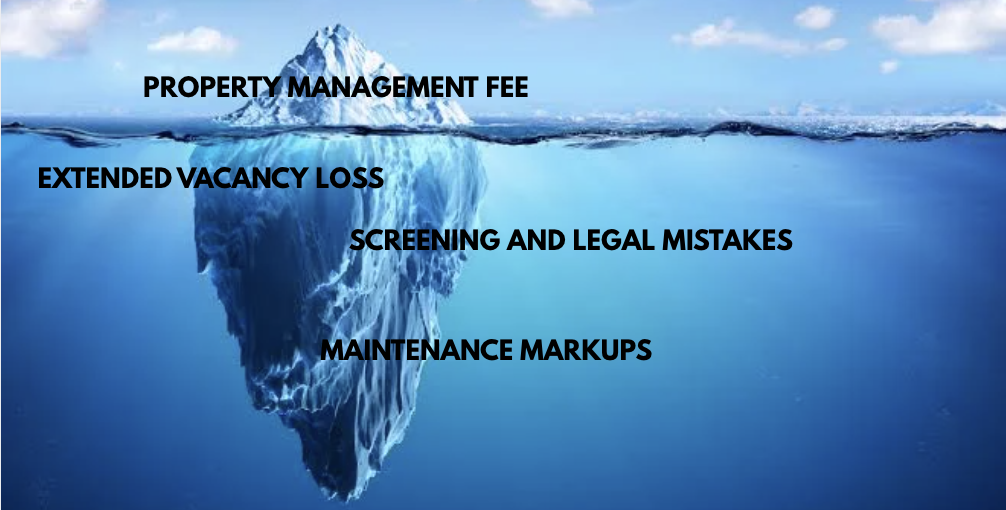
    Managing your own rental looks free on paper. No management fee, no middleman, no cut out of your monthly rent check. But “free” and “no cost” aren’t the same thing. Once you add up the time, the mistakes, and the markups that come with doing it all yourself, the hidden costs of self-managing your rental often outweigh whatever fee you were trying to avoid in the first place.

    Here are three of the biggest ones — and why the true cost of self-managing a rental property rarely shows up on a single line item.

    1. Extended vacancy loss

    Every day a unit sits empty, you’re paying the mortgage, insurance, and utilities on a property that’s generating zero income. Self-managing owners tend to see longer vacancies for a few predictable reasons: fewer marketing channels than a professional manager has access to, slower response times to inquiries because you’re fitting showings around a full-time job, and pricing that’s based on a rough estimate rather than current, hyperlocal comparables.

    A week or two of extra vacancy might not sound like much. Multiplied across a 12-month lease, it can quietly wipe out what you thought you were saving by not paying a management fee.

    Tenant screening looks simple until you’re the one deciding whether an applicant’s explanation for a low credit score or a gap in rental history is a red flag or a reasonable story. Get it wrong, and the cost isn’t just a bad tenant — it’s unpaid rent, property damage, and potentially a drawn-out eviction process.

    California’s landlord-tenant laws add another layer of risk. Notice requirements, security deposit rules, and fair housing compliance all carry real financial exposure if handled incorrectly — even unintentionally. A single missed deadline or improperly worded notice can turn a routine tenant issue into a legal expense that dwarfs any management fee you were hoping to avoid.

    3. Maintenance markups

    Without an established network of vendors, most self-managing owners end up calling around for whoever’s available — and paying retail rates for it. There’s no volume pricing, no negotiated rate, and often no second opinion on whether a quote is fair. Emergency repairs are worse: a plumber or handyman who knows you need someone right now has little incentive to give you their best price.

    Beyond the dollar cost, there’s the coordination cost — the calls, the follow-ups, the trip to let the vendor in because you couldn’t find one who’d do it without you present. That’s time that has a cost too, even if it never shows up on an invoice.

    What this actually adds up to

    None of these costs are dramatic on their own. A slightly longer vacancy here, a slightly higher repair bill there. But stacked together over a year, the true cost of self-managing a rental property is usually much higher than owners expect — and much harder to see coming than a flat monthly management fee. If any of this sounds familiar, it may be worth revisiting whether self-managing is still saving you anything. For a closer look at how to evaluate that tradeoff, see our post on 5 signs it’s time to hire a property manager in Huntington Beach. For general guidance on landlord recordkeeping and expenses, the IRS’s guide to rental property income and expenses is a useful outside reference.

    How Smart One keeps costs predictable

    At Smart One, we replace unpredictable, one-off expenses with an all-inclusive management fee — no surprise markups, no guessing what a repair will actually cost. Our maintenance coordination runs through an established vendor network, our marketing fills vacancies faster, and our screening process is built to catch the red flags before they become expensive problems.

    Curious what your rental would look like with predictable costs and no hidden surprises? Contact Smart One Property Management today.

  • 5 Signs It’s Time to Hire a Property Manager in Orange County

    Owning a rental property in Long Beach or Orange County sounded simple at the start: collect rent, cover the mortgage, watch the equity build. Then the first 11pm maintenance call came in. Or a tenant stopped paying and you weren’t sure what to do next. Or you realized you’d spent your entire Saturday driving out to show a vacant unit to someone who never showed up.

    Self-managing works for some owners. For others, it quietly turns into a second job — one that eats into the time, energy, and profit the property was supposed to create. Here are five signs it might be time to bring in a property manager.

    1. You’re losing more time than the property is worth

    Every hour spent fielding maintenance calls, chasing late rent, or coordinating a showing is an hour you’re not getting paid for. If you added up the time you spend managing your rental each month and multiplied it by what your time is actually worth, would the math still make sense? For a lot of owners, the honest answer is no — the property is profitable on paper, but the time cost quietly cancels it out.

    2. Vacancies are dragging on longer than they should

    A vacant unit costs you money every single day it sits empty — not just in lost rent, but in the mortgage, insurance, and utilities you’re still paying regardless. If your listings are taking weeks longer to fill than comparable units nearby, the issue usually isn’t the property. It’s marketing reach, pricing, or the inability to show the unit quickly to serious renters. A property manager with local market knowledge and an established process for filling vacancies fast can turn that around.

    3. You’ve had a tenant problem you didn’t know how to handle

    Late payments, lease violations, property damage, or a tenant who simply won’t respond — these situations come up eventually, and California’s landlord-tenant laws don’t leave much room for guesswork. One mishandled notice or missed deadline can turn a simple issue into a costly legal one. If you’ve ever found yourself Googling “can I evict a tenant for…” at 10pm, that’s usually a sign you’d benefit from someone who handles these situations for a living.

    4. Maintenance requests are a constant source of stress

    Coordinating repairs sounds straightforward until you’re the one fielding the call, finding a vendor who’s actually available, negotiating the price, and following up to make sure the work got done right. Self-managed maintenance also tends to cost more — without an established network of vendors, owners often end up paying premium rates for basic repairs. Dedicated maintenance coordination means requests get handled quickly and correctly, without you being the middleman for every leaky faucet.

    5. You’re not sure your rent is priced right

    The Huntington Beach and Orange County rental market shifts throughout the year, and pricing a unit even slightly below market adds up to real money over a 12-month lease. Price it too high, and you’re the reason it’s sitting vacant. Most self-managing owners are relying on a Zillow estimate or what the last tenant paid — not current, hyperlocal data. A property manager who works in your specific market day to day can tell you what your unit should actually rent for right now.

    What this is really costing you

    None of these signs are a failure on your part — they’re just what happens when a job that requires local market knowledge, legal awareness, vendor relationships, and constant availability gets handled part-time, on top of everything else you’re already doing. The question isn’t whether you’re capable of self-managing. It’s whether it’s still the best use of your time and the smartest way to protect your investment.

    How Smart One Property Management Is Different

    At Smart One, we handle the parts of property management that wear owners down — in-person showings instead of lockbox-and-hope, dedicated maintenance coordination instead of you being the middleman, and one all-inclusive fee instead of surprise add-ons buried in a contract. And when you call, a real person answers. Not a call center, not an app-only support queue.

    If any of the five signs above sound familiar, let’s talk about what professional management would actually look like for your property.

    Ready to see what your rental could look like with the right support? Call Smart One Property Management today for a free rental analysis.

  • That 19% Housing-Starts Jump Isn’t What It Looks Like

    The latest construction report from the U.S. Census Bureau and HUD showed housing starts up 19% in June — a number that sounds like a construction boom. It isn’t quite that simple, and the details matter more to property owners and investors than the headline does.

    The increase was concentrated, not broad-based. Single-family starts actually dipped slightly in June, coming in essentially flat. Nearly all of the jump came from multifamily construction — apartment buildings, which count differently in the data. A single 250-unit building registers as 250 “starts” the moment ground breaks, the same as 250 separate single-family homes taking months to build. Both add supply, but they don’t compete for the same buyers or affect the same neighborhoods.

    Permits tell a more cautious story. Building permits, which signal what’s authorized next, fell 3% overall, with single-family permits down 2.4%. Builders aren’t rushing to expand the future single-family pipeline — they’re pulling back on it, even as multifamily activity surged.

    Completions are the number that actually matters right now. While single-family starts barely moved, single-family completions rose 6.6% in June. That’s the stage of construction most likely to hit the market soon: completed homes become listings, quick-move-in inventory, and direct competition for resale sellers. A slower future pipeline doesn’t mean less competition today — homes started months ago are still landing on the market now.

    New-home inventory is still meaningful. Nationally, builders had about 10.3 months of new single-family homes for sale as of the latest report. That inventory doesn’t sit still — builders move it with mortgage-rate buydowns, closing-cost credits, design upgrades, and other incentives that don’t always show up in the recorded sale price. A resale home priced right on paper can still lose a buyer to a builder incentive package next door.

    None of this lands evenly. New construction competes by price band and location, not by national headline. A luxury resale home isn’t affected by an entry-level townhome community. A new apartment complex may barely register in one neighborhood and reshape rents in another. The national report tells you the direction; only the local numbers tell you what it means for a specific property.

    What this means if you own or manage property locally

    National data is a starting point, not a forecast for Huntington Beach or Orange County specifically. The questions that actually matter are local: How much completed builder inventory is nearby? Are new apartment communities offering concessions that could pull tenants away? Are single-family permits in this submarket rising or slowing? Is a property’s price band facing real new-construction competition, or none at all?

    This is the layer of analysis that gets lost in a headline number — and it’s exactly where property owners and investors benefit from a local partner watching the market rather than a national statistic. At Smart One Property Management, we track what’s actually happening in Huntington Beach and Orange County: local permit activity, nearby builder inventory, rental concessions, and how they affect what a property can rent for or compete against. Whether you own a single rental home or a growing portfolio, that local read is what protects your pricing, your occupancy, and your long-term returns — not the national headline.

    Thinking about how local construction trends might affect your property or investment strategy? Let’s talk. Contact us at (714) 830-1318 today or email us at info@smartonepropertymanagement.com.