
Home prices and mortgage rates get most of the attention when people talk about affordability. But for many first-time buyers, the obstacle comes earlier: the cash needed just to get to the closing table. Looking at the first-time homebuyer down payment next to what typical young households actually hold in savings shows how wide that gap can be.
What first-time buyers actually put down
According to the National Association of Realtors’ most recent buyer profile, the median first-time buyer put down 10% of the purchase price, the highest share since 1989, compared with 23% for repeat buyers. Those aren’t the minimums. Loan programs allow far less: FHA loans require as little as 3.5% down with a qualifying credit score, some conventional programs allow 3%, and VA and USDA loans can require nothing. But buyers who can put more down often do, partly to strengthen offers and lower their monthly payment.
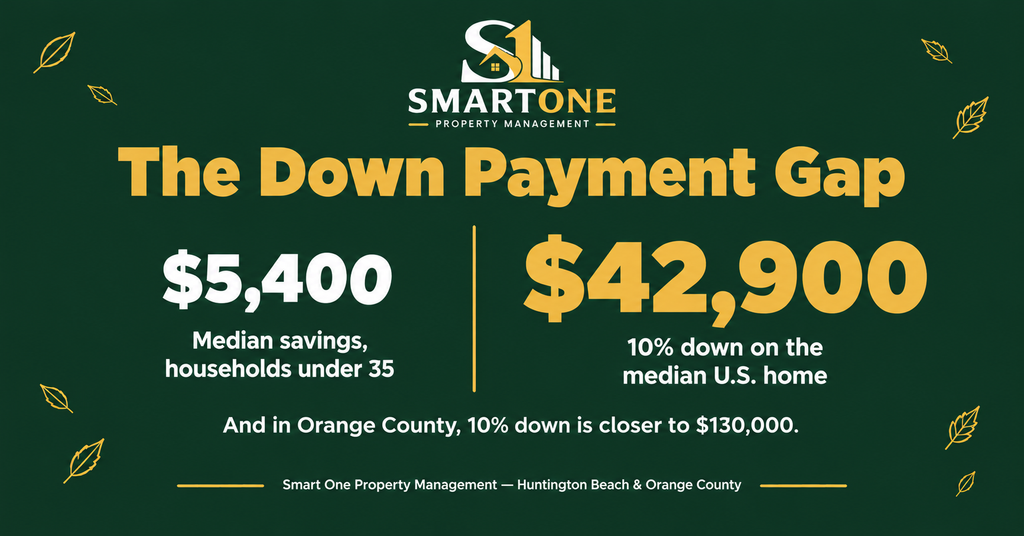
Applied to a national median existing-home price of about $429,100, a 10% down payment comes to roughly $42,900. A 3.5% FHA down payment is about $15,000. And that’s before closing costs, moving costs, and the cash reserves lenders like to see.
What young households have saved
The best publicly available benchmark comes from the Federal Reserve’s Survey of Consumer Finances. In its most recent complete survey (2022), households headed by someone under 35 had a median balance of about $5,400 in checking, savings, and money-market accounts, with an average closer to $20,500. The gap between median and average shows how unevenly savings are distributed, with a smaller number of households holding much more.
Two cautions apply. That figure covers all households under 35, not only those planning to buy, and it’s dated, so today’s numbers may differ. It also leaves out money held in retirement or investment accounts, and gifts or loans from family, which many first-time buyers rely on. A recent survey cited by U.S. News found that 59% of buyers used personal savings, while more than one in five prospective buyers said they planned to tap retirement accounts to help fund a down payment.
Even with those limits, the comparison is stark: a typical young household’s liquid savings are a fraction of even a 10% down payment.
Orange County makes the math harder
As we covered in our starter home post, Orange County’s median home price is well above $1 million. Using a round $1.3 million for illustration, a 3.5% down payment is about $45,500, a 10% down payment is about $130,000, and a 20% down payment is about $260,000. Those figures are illustrative and vary by property and loan, but they show why so many local buyers are priced out even when they have solid incomes and good credit.
What it means for rental owners
When saving for a down payment takes years, many would-be buyers stay renters in the meantime. It’s one more structural reason, alongside high rates and the record number of young adults living with their parents, that rental demand tends to stay durable even when the for-sale market is slow. Rising rents also make saving harder, which can stretch that timeline further.
For owners, the takeaway is the same as in our earlier posts: pricing accurately and keeping units well-maintained matters, because demand from long-term renters isn’t going away soon.
Where help exists
Down payment assistance programs exist at the state and local level, including through the California Housing Finance Agency, and eligibility rules change, so buyers should check current requirements directly.
This post is general information, not financial advice. Talk with a licensed mortgage professional about your specific situation.
Own a rental and want to understand how buyer affordability affects your local demand? Reach out to Smart One Property Management.
Sources: Experian, Average Savings by Age (citing the Federal Reserve’s Survey of Consumer Finances); U.S. News, The Price of Entry May Be Dropping for Prospective Homebuyers; Motley Fool, The Median Down Payment on a Home.