
Most owners buy landlord insurance expecting it to cover “the rental.” The trouble is that “the rental” isn’t one thing. It’s a building, your income from it, your liability to the people who visit it, and a tenant’s belongings inside it, and a standard policy treats each of those differently. Knowing what landlord insurance covers, and where it stops, is the difference between a smooth claim and an unpleasant surprise.
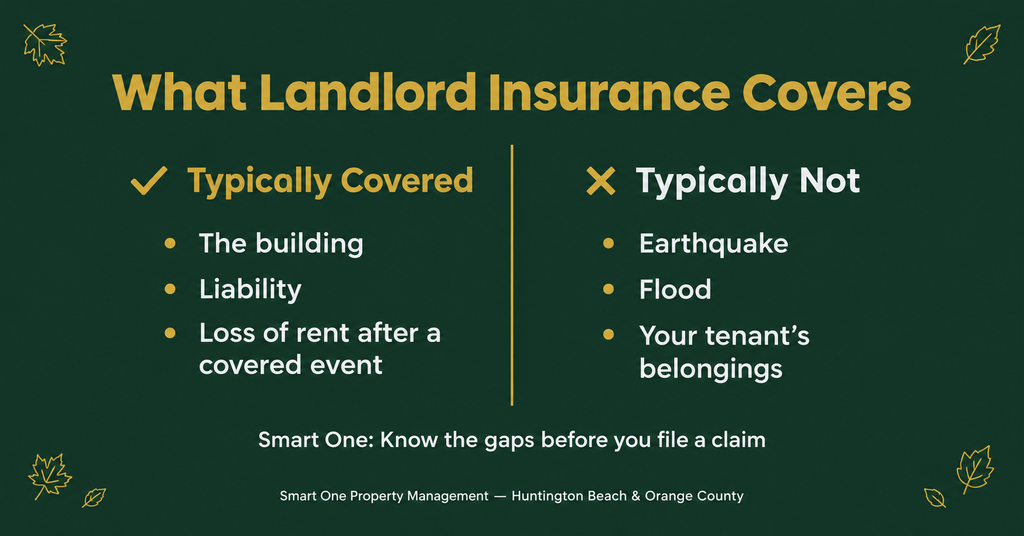
What a landlord policy typically covers
The building. Dwelling coverage pays to repair or rebuild the structure after a covered event such as fire, wind, or certain types of water damage.
Other structures. Detached garages, fences, and sheds on the property are usually covered separately from the main building.
Liability. If a tenant or visitor is injured on the property and you’re found responsible, liability coverage can help with legal costs and settlements.
Loss of rental income. If a covered event makes the unit uninhabitable, this coverage can replace rent you’d otherwise have collected while repairs are underway. The key phrase is covered event: the coverage only applies when the cause of the damage is itself covered by the policy.
Your own property. Appliances or furnishings you supply to the unit are typically covered, subject to policy limits.
What it typically doesn’t cover
Your tenant’s belongings. A landlord policy protects what you own, not what your tenant owns. Their possessions are covered only by their own renters insurance. Many landlords require tenants to carry a policy in the lease, though it’s worth confirming the details with an attorney.
Earthquake. This is the big one in California. Standard policies exclude earthquake damage, and coverage has to be added separately, for example through the California Earthquake Authority or a private carrier. Earthquake policies commonly carry deductibles set as a percentage of the dwelling limit, often in the range of 10% to 25%, rather than a flat dollar amount. One nuance: a fire that results from an earthquake is generally still covered under a fire policy, though the shaking damage itself is not.
Flood. Also excluded from standard policies. It requires its own policy, through the National Flood Insurance Program or a private insurer.
Wear, tear, and neglect. Insurance covers sudden and accidental damage, not the gradual aging of a roof or plumbing, or problems that come from deferred maintenance.
Some tenant-related losses. Coverage for damage or theft involving tenants varies a lot between policies, and so does coverage for unpaid rent. These are areas where reading the actual policy language matters more than any general rule.
Fire and wildfire risk in California
Fire is a core covered peril on most landlord policies, but in California, whether you can get and keep that coverage has become its own question. In recent years, many insurers have limited new policies or declined to renew existing ones in areas with higher wildfire risk, and owners in those areas have sometimes had to look elsewhere for coverage.
One option is the California FAIR Plan, the state’s insurer of last resort. Its dwelling policy is generally limited to fire-related perils, such as fire, lightning, internal explosion, and smoke, and it typically doesn’t include liability coverage or other protections found in a full landlord policy. Owners who end up on the FAIR Plan often pair it with a separate “difference in conditions” (DIC) policy or a standalone liability policy to fill those gaps.
Because this area is changing quickly, and because rules and eligibility for rental properties can differ from those for owner-occupied homes, it’s worth asking your agent two specific questions: whether your property’s coverage could be affected by its location, and whether loss of rental income would still be covered if a fire made the unit uninhabitable under the policy you have, or might end up with. You can also check current rules directly with the California Department of Insurance.
Why the gaps matter
Most of the surprises tend to come from the same few places: earthquake and flood assumed to be covered when they aren’t, loss-of-rent coverage that doesn’t apply because the underlying cause isn’t covered, and tenants who skipped renters insurance and then look to the owner after a loss. A short conversation with an insurance agent about your specific property and location, before something happens, costs far less than discovering the gap afterward.
The takeaway
Landlord insurance is built to protect your investment, not to cover everything that can go wrong with it. Know what’s included, know what isn’t, and decide deliberately which gaps to close with additional coverage and which risks to accept.
This post is general information, not insurance or legal advice. Policies vary by carrier and state, so review your own policy and talk with a licensed insurance professional.
Want help making sure your rental is set up with the right protections and lease terms? Reach out to Smart One Property Management.
Sources: Steadily, What Does Landlord Insurance Not Cover?; Inszone Insurance, California Landlord Insurance Guide; Schneiderman Insurance, California Earthquake Insurance Coverage.