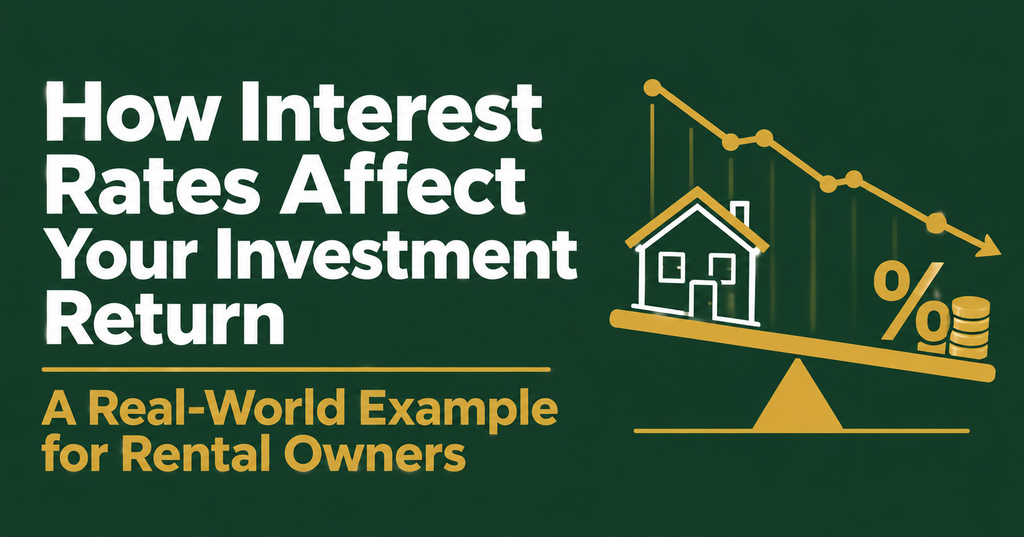
Interest rates are the single biggest line item for most financed rentals, which makes them one of the most powerful forces on your return. A change of just a point or two can turn a comfortable cash flow into a loss. Here is how interest rates affect investment property returns, with a worked example that shows the effect in dollars.
A simple example
The numbers below are illustrative, not a prediction or a real property. Imagine a $500,000 rental purchased with 20% down ($100,000) and a $400,000 30-year fixed-rate loan. The property produces $30,000 a year in net operating income (NOI), which is rental income after operating expenses but before loan payments. That is a 6% cap rate, and it stays the same no matter what the rate is, because cap rate doesn’t depend on financing.
Here is what happens at three different interest rates:
| Interest rate | Monthly payment (principal and interest) | Annual debt service | Annual cash flow | Cash-on-cash return |
|---|---|---|---|---|
| 5.5% | $2,271 | $27,254 | +$2,746 | 2.75% |
| 6.5% | $2,528 | $30,339 | -$339 | -0.34% |
| 7.5% | $2,797 | $33,562 | -$3,562 | -3.56% |
Same property, same rent, same tenant. A two-point swing in the interest rate moved the investor from a small profit to a loss of more than $3,500 a year. The property didn’t get worse; the cost of borrowing got higher. (These figures leave out taxes, insurance, reserves, and other costs, so real-world results would differ.)
Why the effect is so large
Rates act on your return through leverage. Borrowing lets you control a larger asset with less cash, which can boost returns when the property earns more than the loan costs. When the loan costs about as much as the property earns, as in the 6.5% line above, leverage stops helping. When it costs more, leverage works against you, a situation sometimes called negative leverage. We covered the difference between cap rate and cash-on-cash return earlier, and this example shows why both matter: the cap rate never moved, but the cash-on-cash return did.
Other ways rates affect investors
Qualifying for the loan. Higher rates mean higher payments, which can affect how much a lender will approve. For DSCR loans, which look at whether the property’s income covers its payment, a rate increase can push a deal below the lender’s threshold. See our post on investment property loans for how the main loan types compare.
Purchase prices. In theory, higher rates push buyers to demand lower prices or higher yields, but in practice prices depend on local supply and demand, and Orange County’s inventory has kept prices high even when rates have risen.
Adjustable-rate loans and refinancing. If you hold an adjustable-rate loan or plan to refinance, your payment can change. Owners with older, lower-rate loans may be reluctant to sell, which is one reason inventory has stayed tight.
Exit value. Buyers of your property will face the same rate environment, which can influence what they’re willing to pay when you sell.
What you can do about it
You can’t control rates, but you can stress-test your deal against them. Before buying or refinancing, run the numbers at your expected rate and at a rate a point or two higher, as we described in how to run the numbers before buying a rental. If the deal only works at the best-case rate, it’s fragile. Other levers include a larger down payment, a different loan structure, or looking for properties with stronger income. Keeping the unit leased and expenses under control helps too, since NOI is the other half of the equation.
If you plan to hold for years, remember that rates have moved in cycles. Some investors buy when rates are higher and plan to refinance if they fall, but that strategy carries its own risk: there’s no guarantee rates will drop when you need them to, and refinancing involves costs.
This post is general information, not financial, tax, or lending advice. The example is hypothetical and simplified. Talk with a licensed mortgage professional and a qualified advisor about your situation.
Want a second opinion on the numbers for your rental or a property you’re considering? Reach out to Smart One Property Management and speak with our in-house licensed mortgage professional.
Sources: Calculations are the author’s, using the standard fixed-rate amortization formula for a $400,000 loan over 30 years; see also Lending One, DSCR Loan vs. Conventional Loan for background on how lenders evaluate investment loans.