Category: Uncategorized

  • What Happens When a Tenant Stops Paying Rent?

    Rent doesn’t show up on the first, and now what? What happens when a tenant stops paying rent is one of the most stressful situations a self-managing owner can face — partly because of the lost income, and partly because California gives landlords a specific, legally required process to follow, with real consequences for skipping steps.
    Step 1: Confirm and document

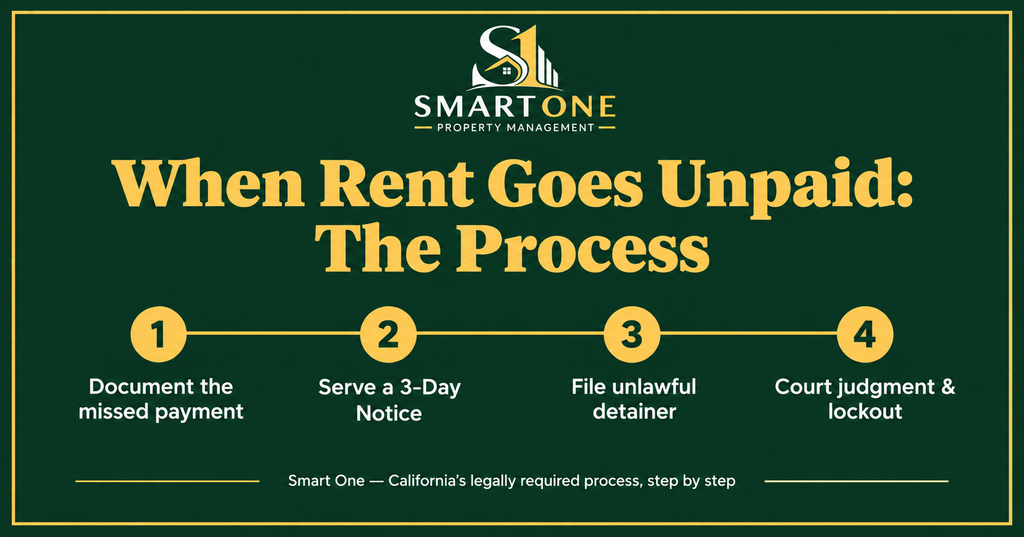
    Before anything else, confirm the payment genuinely didn’t arrive — a bank delay or a processing error happens more often than people expect — and document the missed payment with a date and amount. This record matters if the situation escalates.

    Step 2: Serve a 3-Day Notice to Pay Rent or Quit

    If rent is genuinely unpaid, the next legally required step is a 3-Day Notice to Pay Rent or Quit. To be valid in California, the notice needs the full legal names of all tenants on the lease, clear instructions for how and where to pay, a specific expiration date, and it must account for the fact that weekends and judicial holidays don’t count toward the three days — so a notice served on a Thursday effectively runs into the following week. The notice can only demand the actual unpaid rent — not late fees, utility charges, or other add-on costs, even if those are also technically owed.

    Step 3: What happens if the tenant pays — or doesn’t

    If the tenant pays the full amount demanded within the notice period, that typically resolves the situation, and the notice is satisfied. If they don’t pay and don’t move out, the next step is filing an unlawful detainer lawsuit in Superior Court — this is the formal legal term for an eviction case.

    Step 4: The unlawful detainer process

    Once filed, the tenant is served with a summons and complaint and has 10 business days to file a written response. If they don’t respond in time, the landlord can request a default judgment. If they do respond, the case proceeds through the court process, which can take additional weeks depending on the court’s schedule and whether the tenant contests it.

    What you can’t do — even if you’re frustrated

    California law is strict on this point: the only lawful way to remove a tenant is a court judgment followed by a sheriff-executed lockout. Changing the locks, shutting off utilities, removing a tenant’s belongings, or any other “self-help” eviction is illegal in California, regardless of how much rent is owed or how clearly the tenant is in the wrong. Taking matters into your own hands can expose you to real liability — including potential damages owed to the tenant — on top of the unpaid rent you were already trying to collect.

    Before you escalate

    Not every missed payment needs to go straight to a formal notice. A tenant with an otherwise solid payment history who’s dealing with a genuine, temporary hardship may be worth a conversation and a documented partial-payment plan before escalating — that’s a business judgment call, not a legal requirement, but it’s often the difference between resolving something quickly and losing a good tenant over one rough month. Whatever you decide, document it in writing either way.

    Why this is where self-managing owners feel the most pressure

    The timelines, notice requirements, and prohibition on self-help eviction are exactly the kind of process a property manager runs routinely rather than learning for the first time under stress. The California Courts Self-Help Center’s eviction guide is a solid starting point for understanding the process, but timing and paperwork mistakes are common even with good information in hand.

    Dealing with a tenant who’s stopped paying and not sure what to do next? Reach out to Smart One Property Management.

    ****Disclaimer: This article is for general informational purposes only and does not constitute legal advice. Laws affecting landlords and tenants change frequently and can vary by city and county. Before taking action based on this information, please consult a licensed attorney regarding your specific situation.


  • Why Every Real Estate Investor’s Goal Is Different — And Why That Should Change Your Recommendation

    Not every investor wants the same thing — and treating them like they do is one of the most common mistakes an agent can make. Two clients can both call themselves “real estate investors” and want almost opposite properties, in opposite locations, at opposite price points. The agent who understands real estate investor goals before making a recommendation serves the client well. The agent who doesn’t ends up showing the wrong properties, losing trust, or — worse — putting a client into a deal that doesn’t actually fit what they were trying to accomplish.

    The goals aren’t all the same

    Cash flow. Some investors want monthly income, full stop. They’re less concerned with a property’s long-term appreciation potential and more focused on rent-to-price ratio, vacancy risk, and ongoing operating costs. A high-appreciation neighborhood with thin cash flow margins is often the wrong fit here, even if it looks like a “good” investment on paper.

    Appreciation. Other investors are playing a longer game — they’re comfortable with lower or even negative cash flow in exchange for equity growth over time. These clients are often more focused on location fundamentals, growth trends, and future development than on this month’s rent roll.

    Tax strategy. Some investors are moving equity out of one property and into another specifically to defer capital gains through a 1031 exchange, or structuring a purchase around depreciation and other tax benefits. These transactions come with strict timelines and requirements — the IRS’s guidance on like-kind exchanges is worth understanding well enough to at least recognize when a client should be talking to their CPA before, not after, they make an offer.

    Portfolio diversification. Some clients aren’t looking for their best possible deal — they’re looking for a specific piece to round out a portfolio: a different property type, a different market, or a different level of risk than what they already own.

    Value-add or short-term. Flippers and short-term investors need a completely different lens — after-repair value, renovation cost estimates, and holding costs during the project, rather than long-term rent projections at all.

    Legacy and generational wealth. Some investors aren’t optimizing for return at all in the traditional sense. They’re building something to pass down, and stability, location, and long-term hold potential matter more than maximizing yield.

    Why this matters more than it seems

    Recommending a property without understanding which of these goals a client is actually working toward isn’t just inefficient — it can actively work against them. A cash-flow investor steered toward an appreciation play may end up subsidizing a property every month and resenting the advice that put them there. A legacy-focused client pushed toward an aggressive value-add project may take on more risk and hands-on work than they ever wanted. Good intentions don’t prevent a mismatched recommendation from damaging trust, and trust is the entire foundation of a long-term client relationship.

    Questions worth asking before the first showing

    Before pulling listings, it’s worth understanding: Is this investor looking for income now, growth later, or both? What’s their tolerance for hands-on work — value-add and renovation, or a truly passive hold? Is there a tax or timeline consideration driving the purchase, like a 1031 exchange deadline? Is this a standalone investment decision, or part of a broader portfolio strategy? And just as important — is this a first investment property, or does the client already have experience to draw on?

    The answers change which properties are worth showing at all, not just how they’re presented once you’re there.

    The takeaway

    Every investor is optimizing for something — but it’s rarely the same thing twice. Taking the time to understand a client’s actual goal before making a recommendation isn’t extra work on top of the job. It is the job. It’s the difference between an agent who sells a property and an agent who serves a client.

    Working with investors and want a team that takes the time to understand what you’re actually trying to build? Reach out to Smart One.

  • AppFolio Owner Portal: What It Means for You as a Smart One Client

    Smart One Property Management has moved to AppFolio, one of the property management industry’s leading software platforms, to power how we manage your property and how you stay informed about it. If you’re a current client, here’s what that means for you day to day. If you’re considering Smart One, here’s what to expect once you’re onboard.

    Real-time financial visibility

    The AppFolio owner portal gives you on-demand access to your property’s financial activity — rent collected, expenses, and disbursements — without waiting on a monthly email or a phone call to get an answer. Statements are available online whenever you want to check them, and historical records stay accessible so you can review past months without digging through old paperwork.

    Maintenance updates you can actually see

    When a maintenance request comes in on your property, you can track its status through the portal — from the initial request through vendor scheduling and completion — instead of relying on a recap after the fact. That transparency is part of what dedicated maintenance coordination should include: not just handling the repair, but keeping you informed while it happens.

    Documents and statements in one place

    Leases, inspection reports, and other property documents are stored in the portal, so you’re not searching through email threads to find something you need. Everything tied to your property lives in one account you can access anytime.

    Why we made the switch

    We moved to AppFolio because it gives our clients a more transparent, real-time view into their property than our previous system did — and because it lets our team manage maintenance coordination, accounting, and communication more efficiently, which translates directly into faster response times for you. This wasn’t a change we made lightly; it’s an investment in the kind of visibility and responsiveness we think property management should include as a baseline, not an upgrade.

    Getting started

    If you’re a current Smart One client, you’ll receive an email invitation to set up your AppFolio owner portal login — reach out to our team if you haven’t received yours or need help getting set up. If you’re not yet a client and this kind of visibility is something you’ve been missing with your current management situation, this is exactly the kind of transparency we’ve built our process around.

    Questions about the new portal, or curious what real-time visibility into your property could look like? Reach out to Smart One Property Management today.

  • Buyers Are Sitting on the Sidelines. Here’s What That Means for Rental Owners.

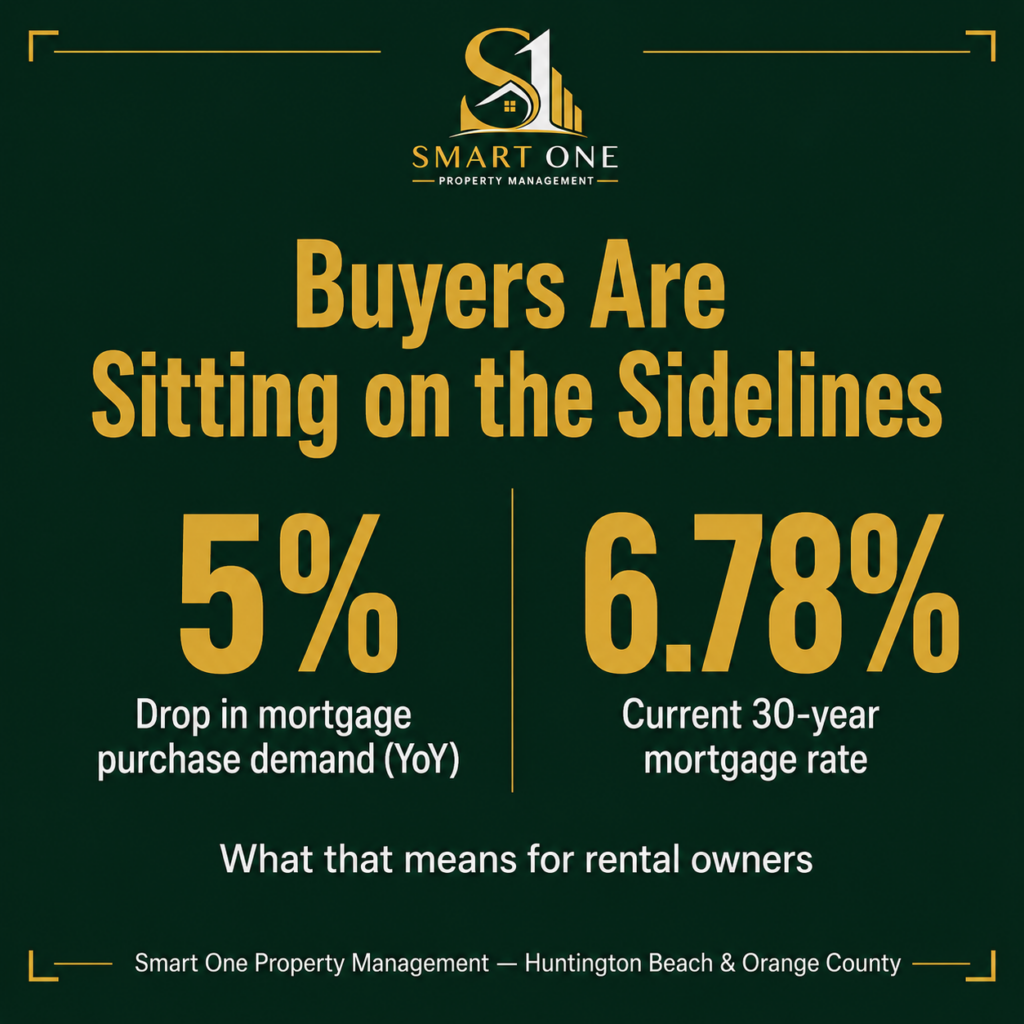
    Mortgage purchase applications are down 5% compared to this time last year, according to the Mortgage Bankers Association’s weekly survey for the period ending August 21, 2026. The 30-year fixed rate climbed to 6.78% — its highest level in three weeks — and refinance activity fell even further, down 17% year-over-year. On its own, that’s a data point about homebuyers. For rental property owners, it’s also a signal worth paying attention to.

    Why fewer buyers doesn’t mean less demand overall

    When mortgage rates rise, some people who would otherwise be buying a home stay renters instead — either because a monthly mortgage payment no longer pencils out compared to rent, or because they can’t qualify at current rates. That doesn’t shrink the total number of households needing housing. It shifts some of them from the buy side of the market to the rental side, which tends to support rental demand even while home sales activity cools.

    This is part of why rental vacancy in tighter markets like Orange County has stayed low even as national housing headlines have been mixed — the same rate environment that’s freezing out some buyers is keeping some renters renting longer than they might have otherwise planned to.

    What this means if you’re financing a purchase

    If you’re an investor considering financing an additional property right now, a 6.78% rate changes the math on returns compared to a lower-rate environment — higher monthly debt service eats into cash flow, which is exactly the kind of detail that should factor into understanding your goals before making a purchase decision. It doesn’t necessarily mean it’s the wrong time to buy; it means the numbers need to work at today’s rates, not last year’s.

    What this means if you already own

    For owners who financed at a lower rate, this environment is a reminder that your existing mortgage is a genuine asset — refinancing into today’s rates would likely raise your payment, not lower it, so unless there’s a specific reason to refinance (pulling equity, changing loan terms), there’s little incentive to touch it right now. For owners deciding whether to sell or hold, softer purchase demand can mean a longer time-to-sale if you’re weighing a sale, which is worth factoring in alongside the current rental vacancy picture in your specific market.

    The bigger picture

    Rate-driven shifts like this tend to move slowly and unevenly — national purchase demand data doesn’t translate one-to-one into what’s happening in any single Orange County submarket. But the general pattern is worth tracking: as long as borrowing stays expensive relative to rent, rental demand has a tailwind that owners can benefit from, provided pricing and property condition are keeping pace with what renters in the current market actually expect.

    Want help thinking through what today’s rate environment means for your specific property or portfolio? Reach out to Smart One Property Management.

    Source: Mortgage Bankers Association, Mortgage Applications Decrease in Latest MBA Weekly Survey, week ending August 21, 2026.

  • Maintenance Coordination: Why DIY Landlords Get Burned

    A maintenance request seems simple enough: something breaks, you find someone to fix it, the tenant’s happy, you move on. In practice, that’s where a lot of self-managing owners get burned. DIY maintenance coordination mistakes rarely show up as one big disaster — they show up as a slow drip of overpaid invoices, frustrated tenants, and the occasional legal exposure nobody saw coming.

    No vendor relationships means no leverage

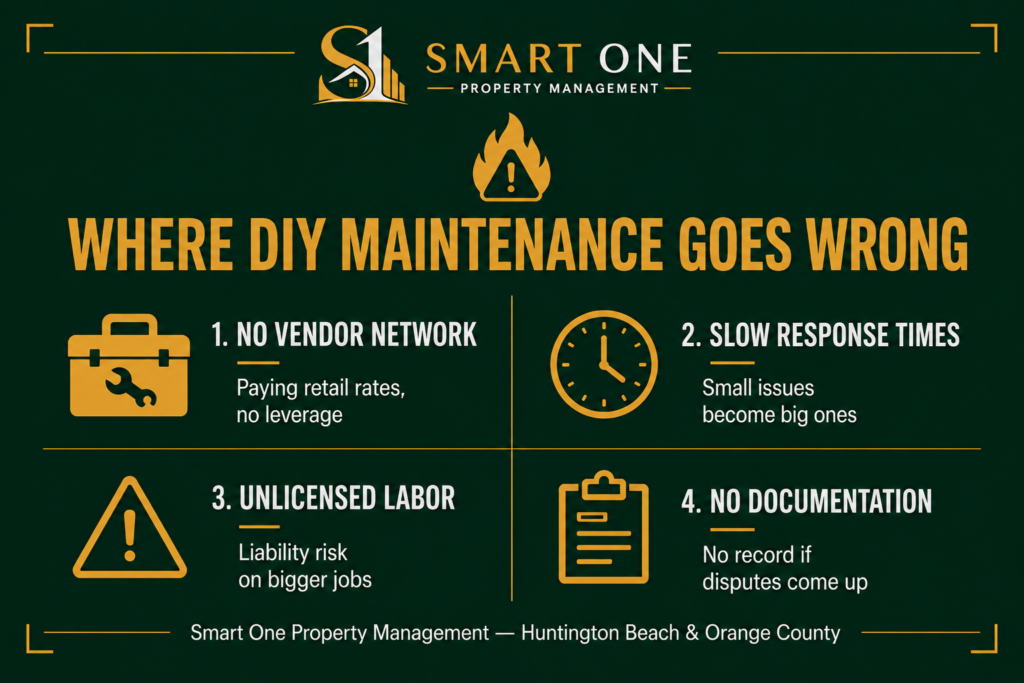
    Without an established network, most self-managing owners are calling around for whoever’s available — and paying whatever that vendor asks. There’s no negotiated rate, no volume pricing, and no easy way to know if a quote is fair without getting a second one, which takes even more time. Emergency repairs make this worse: a vendor who knows you need someone tonight has little incentive to give you their best price.

    Slow response times turn small problems into big ones

    A minor leak reported on a Friday and not addressed until Monday can turn into water damage, mold, or a habitability complaint by the time anyone gets to it. California law requires landlords to maintain rental units in habitable condition, and delays in addressing things like heating, plumbing, or safety issues can create real legal exposure — not just an unhappy tenant. Dedicated maintenance coordination exists specifically to close that gap between “reported” and “resolved.”

    Hiring the wrong person for the job

    Not every repair is a handyman job. In California, most work over $500 in combined labor and materials legally requires a licensed contractor, and using an unlicensed person for larger jobs — even someone reliable and cheap — can create liability if something goes wrong later. The California Contractors State License Board has guidance on when a license is actually required, and it’s worth knowing before hiring anyone for anything beyond a basic fix.

    Poor documentation

    When maintenance requests, vendor communications, and repair timelines only exist in text messages and memory, there’s no clear record if a tenant later disputes what was fixed, when, or how well. That gap becomes a real problem if a security deposit dispute or habitability claim ever escalates.

    Why this is where self-managing owners feel it most

    Maintenance is the part of self-managing that tends to wear owners down fastest, because it’s unpredictable — you can’t schedule around a burst pipe. It’s also where the hidden costs of self-managing show up most directly, in markups, delays, and the coordination time nobody accounts for. If maintenance requests are the part of the job you dread most, that’s often one of the clearer signs it’s time to hire a property manager.

    How Smart One handles maintenance differently

    At Smart One, every maintenance request runs through an established, vetted vendor network with negotiated rates — not whoever happens to be available. Requests are tracked and documented from report to resolution, and repairs requiring a licensed contractor are handled by one, every time. Owners get a fixed, predictable process instead of a new gamble every time something breaks.

    Tired of being the one fielding every maintenance call? Contact Smart One Property Management today.

  • FSBO Is Nearly Extinct. Here’s What Sellers Are Really Paying For.

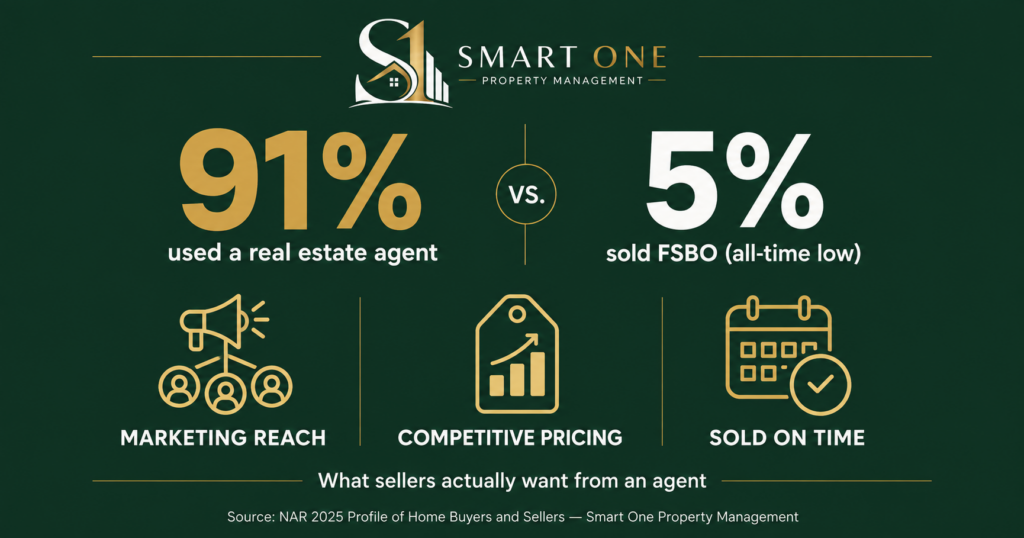
    Agent use among home sellers hit 91% in 2025, matching the highest share ever recorded, according to the National Association of Realtors’ Profile of Home Buyers and Sellers. For Sale By Owner transactions fell to just 5% — an all-time low. On their own, those numbers make a good headline. What’s more useful is what sellers want from a real estate agent in the first place — because that’s what’s actually driving the shift away from FSBO.

    The record numbers, briefly

    Agent-assisted sales have been climbing for years, and 2025 pushed that trend further: 91% of sellers used an agent, up from 90% the year before, while FSBO sales dropped to 5% of the market — the lowest share NAR has ever recorded. Sellers aren’t just defaulting to an agent out of habit. They’re actively choosing professional representation over doing it themselves, and the reasons behind that choice say more than the percentage does.

    What sellers want from a real estate agent

    According to NAR’s 2025 data, sellers’ top priorities in choosing an agent were help marketing the home to potential buyers, help pricing it competitively, and help selling within a specific timeframe. It’s not one thing — it’s the combination. Marketing reach without pricing strategy leads to a home that gets seen but doesn’t sell. Competitive pricing without a real marketing push leaves a well-priced home invisible to the buyers who’d actually want it. Sellers are looking for someone who handles both, along with everything in between.

    That combination shows up in another figure from the same report: 86% of sellers said their agent provided a broad range of services and managed most aspects of the sale — not just the listing, but negotiation, paperwork, inspections, and the dozens of smaller decisions that come up between “for sale” and “sold.”

    Why the 5% still go FSBO

    FSBO sellers aren’t choosing to skip an agent for the same reasons across the board. Roughly 30% of FSBO sales in NAR’s data went to a friend, relative, or neighbor — a transaction where a seller may reasonably feel a full agent-led marketing process isn’t necessary. Others cite avoiding commission costs as the primary driver. It’s worth noting NAR’s data also shows a real price gap between FSBO and agent-assisted sales — a median of $360,000 versus $425,000. That gap almost certainly reflects more than agent involvement alone (FSBO sales skew toward off-market, personal-network transactions that are structured differently from the start), but it’s a reasonable data point for a seller weighing the decision to consider alongside everything else.

    Is FSBO worth it? What to weigh before deciding

    The record-high agent usage number isn’t really the takeaway. The takeaway is what sellers are actually paying for when they choose an agent: broader buyer reach, a pricing strategy grounded in real data rather than a guess, and someone managing the transaction end-to-end so nothing falls through during negotiation, inspection, or closing. If you’re weighing FSBO against hiring an agent, that’s the real comparison to make — not “can I list my house myself,” but “can I replicate the marketing reach, pricing accuracy, and full-service management that’s driving 91% of sellers to choose an agent in the first place.”

    The same logic holds for rental property owners deciding whether to self-manage. The value of professional representation was never about the license — it’s about reach, accurate pricing, and someone managing the full process so nothing gets missed. That’s as true for a rental listing as it is for a home sale.

    Own a rental in Orange County and want that same level of marketing reach, accurate pricing, and full-service management working for you? Reach out to Smart One Property Management.

    Source: National Association of Realtors, 2025 Profile of Home Buyers and Sellers.

  • The National Rental Vacancy Rate Is 7.3%. Orange County’s Isn’t Even Close.

    Image of the pond at Fashion Island in Newport Beach, CA.

    Every quarter, the Census Bureau publishes a national rental vacancy rate, and every quarter it gets treated as a stand-in for “the rental market.” In the second quarter of 2026, that rate was 7.3% — roughly flat compared to a year earlier. If you own rental property in Huntington Beach or elsewhere in Orange County, that number tells you almost nothing about your actual market.

    Orange County is running well below the national rate

    Local data tells a very different story. Orange County’s multifamily vacancy rate was 4.3% in the second quarter of 2026, according to Kidder Mathews’ regional market research — up slightly from 3.8% a year earlier, but still well under national levels. Other local sources put the broader OC vacancy rate closer to 4.0–4.2%. Even with the recent uptick, Orange County remains one of the tighter, more landlord-favorable rental markets in Southern California.

    That gap matters. A landlord reading the national headline might expect softening demand, more negotiating leverage for tenants, or slower rent growth. An Orange County owner working from local numbers sees a market that, while normalizing off historically ultra-low vacancy, is still considerably tighter than most of the country.

    Why the national number and the local one diverge

    Rental vacancy isn’t uniform across the country, and it isn’t even uniform across California. Nationally, the Census Bureau reported rental vacancy at 9.5% in the South, 6.9% in the Midwest, 5.9% in the Northeast, and 5.3% in the West for the second quarter — with cities generally running higher than suburbs. Orange County’s multifamily rate sitting near 4.3% puts it below even the broader Western regional average, a reflection of constrained land supply, high barriers to new construction, and consistently strong demand.

    The slight year-over-year increase locally is worth watching, not ignoring. A move from roughly 3.8% to 4.3% is a real shift after years of vacancy sitting in the 2–3% range, and it’s consistent with new apartment supply working its way through parts of the county. But “up slightly from historically tight” and “loosening market” are two very different stories, and only one of them is accurate here.

    What this means for owners

    If you’re setting rent, evaluating a purchase, or deciding whether to hold or sell a rental property, the national vacancy rate is close to irrelevant. What matters is the vacancy rate in your specific submarket and property type, how it’s trended over the past year, and what’s in the pipeline nearby that could change it — new apartment communities, shifting renter demand, or seasonal patterns specific to the neighborhood.

    That’s the level of detail a property manager should be tracking on your behalf. Smart One Property Management monitors rental vacancy, rent trends, and new supply across Huntington Beach and Orange County so owners can price and manage their properties based on what’s actually happening locally — not a national statistic that doesn’t reflect this market.

    Want to know how your rental compares to current Orange County vacancy and rent trends? Reach out to Smart One Property Management.


    Sources: U.S. Census Bureau, Quarterly Residential Vacancies and Homeownership, Second Quarter 2026, released July 28, 2026; Kidder Mathews, Orange County Multifamily Market Report, Q2 2026.