
The management fee is the easiest number to compare when you’re weighing self-managing vs. hiring a property manager — and it’s also the least useful one on its own. A monthly percentage is easy to see. What it’s replacing is harder to measure, which is exactly why so many owners underestimate what self-managing actually costs them.
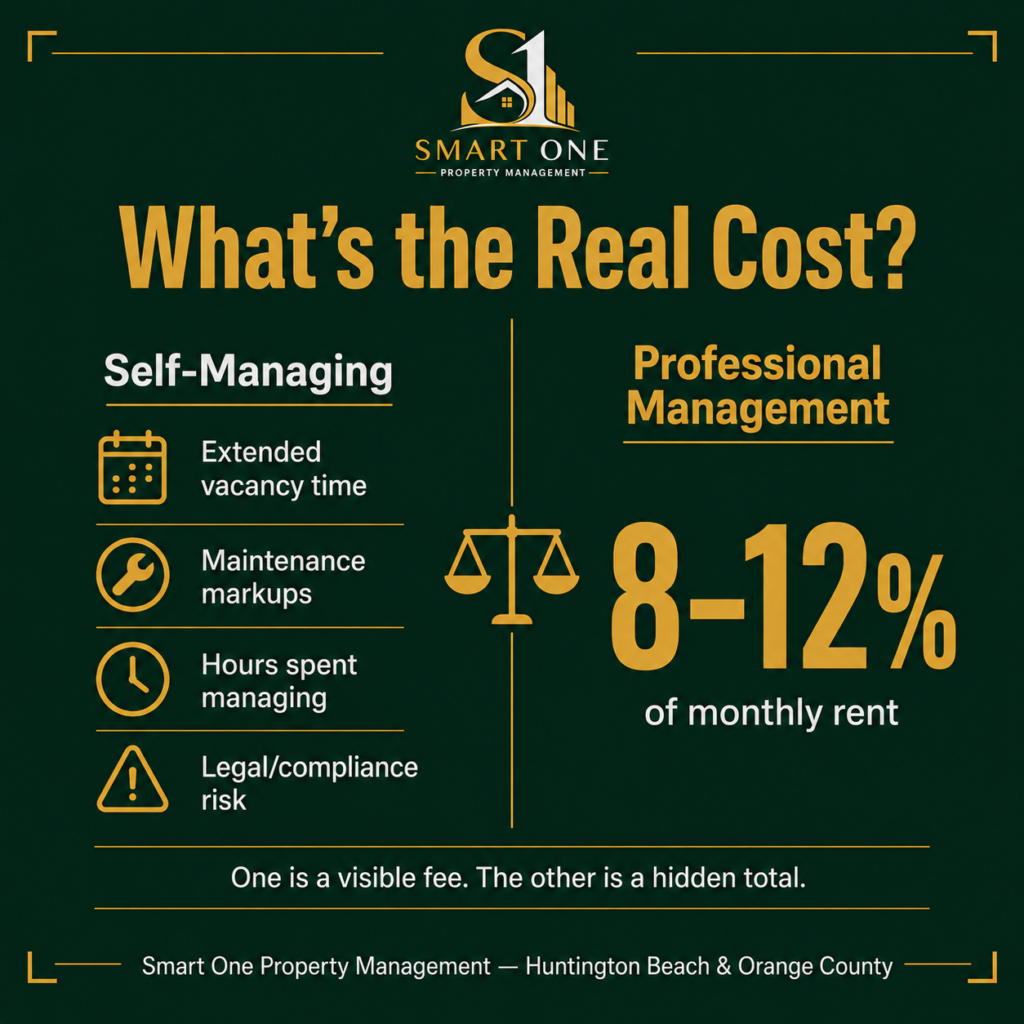
What hiring a property manager actually costs.
Property management fees typically run 8–12% of monthly collected rent, with 10% the most common rate for single-family rentals, according to industry data compiled by All Property Management. Most companies also charge a one-time tenant placement fee, commonly 50–100% of the first month’s rent, when a new tenant is placed. That means first-year costs often run higher than the ongoing monthly rate before settling into a lower, more predictable cost in renewal years.
That’s the visible cost. It buys marketing and showings, tenant screening, rent collection, maintenance coordination, and legal compliance handled by someone who does it full-time.
What self-managing actually costs
Self-managing doesn’t have a line-item fee, which is exactly why it’s easy to underestimate. The real costs show up as extended vacancy time when a listing isn’t priced or marketed as effectively, maintenance markups from paying retail rates without a vendor network, and the time cost of fielding calls, showings, and paperwork yourself — plus the legal exposure if a notice, screening decision, or habitability issue isn’t handled correctly. None of these show up on a single bill, but they add up over a full year in a way that’s easy to miss until you actually total it.
A simple way to run your own numbers
Start with your annual rent roll, then subtract what a property manager would charge (roughly 8–12%, reach out to Smart One today for our most competitive rate). That’s your “cost of hiring.” Then estimate what self-managing has actually cost you: any extra vacancy days beyond what a professionally marketed listing would see, any maintenance costs above what negotiated vendor rates would run, and a reasonable hourly value for the time you spend managing the property, multiplied by hours spent per month. Add those up, and compare the total to the management fee. For many self-managing owners, the gap is smaller than they expect — or the management fee turns out to be cheaper once time and mistakes are priced in honestly.
When self-managing genuinely makes sense
This isn’t a blanket case for hiring a property manager. Self-managing can make sense if you enjoy being hands-on, have the time and proximity to respond quickly, and are comfortable staying current on landlord-tenant law. It tends to make less sense as your portfolio grows, if you don’t live near the property, or if maintenance and tenant issues are the parts of ownership you dread most — that discomfort is usually a more honest signal than the management fee percentage alone.
The real comparison
The management fee isn’t the full cost of self-managing versus hiring help — it’s one side of a comparison that also includes vacancy, maintenance, time, and risk. Running the numbers honestly, rather than comparing “free” to a monthly percentage, is what actually tells you which option makes sense for your property.
Want help running these numbers for your specific property? Contact Smart One Property Management today.